
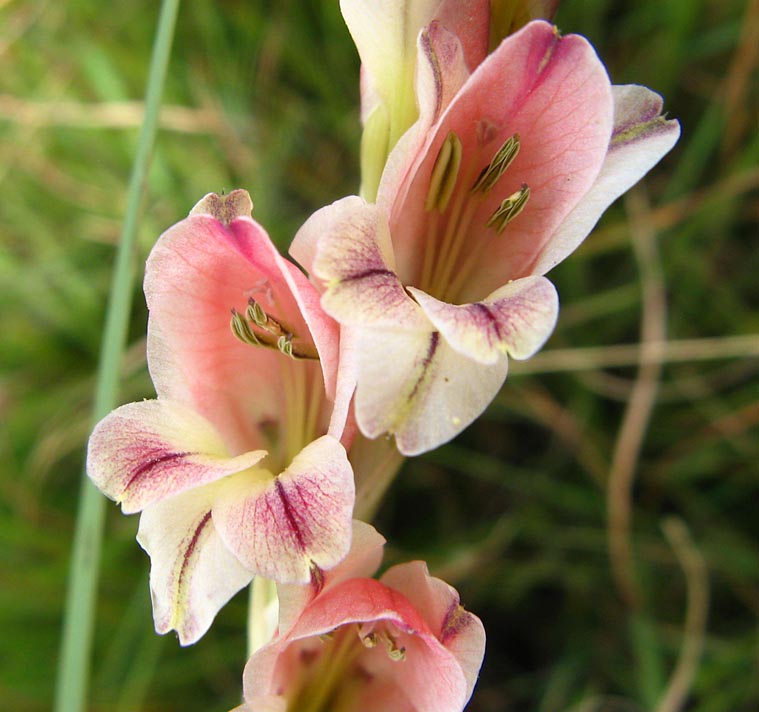
Gladiolus crassifolius
AFRICAN GLADDIES
COLLECTOR’S PACK
$7.50 AUD
Availability: In stock
- 1-9 pkts $5.00
- 10 pkts FREE
- Express post $12
Gladiolus crassifolius
AFRICAN GLADDIES
COLLECTOR’S PACK
Gladiolus crassifolius is little known in Australian gardens – though it should be – as it is ideally suited.
Spires of showy blooms
This beautiful African has large, open mouthed blooms, stacked up on tall wands.
With each stem usually bearing 16 to 22 large blooms.
On elegant wands
So it is both showy in flower and elegant in growth.
And it is a very upright grower, with strong flower stems of 75cm. that rarely if ever need staking.
Blooms of pale & deep pinks veined with purple
The colouring of each flower on Gladiolus crassifolius is lovely – gentle blends of pale and deep pinks on cream background, banded with purple.
Great treat for high summer
Just when you think the riot of spring and early summer colour is waning into dreary.
Then Gladiolus crassifolius struts the stage in high summer, and lifts both garden and spirits.
Though plants in more tropical areas will bloom earlier, in late spring and early summer.
Suits both mediterranean & tropical climates
These beautiful “Gladdie” rhizomes are native to widespread areas across Africa, from South Africa where the Mediterranean style climate is so similar to the south of Australia, to tropical Central Africa.
So we can grow it from Melbourne to Brisbane and even further north.
Commercial quality cut flowers
The lovely wands of blooms make splendid cut flowers.
With large blooms and delightful colouring.
Handsome foliage too
The foliage of Gladiolus crassifolius is also a treat in the garden.
One of the common-names is “Thick Leaf Gladiolus” – because the sword like leaves are broader than most other “Gladdies”.
Plus they have a paler, vertical central stripe and are also edged with light bands.
So the foliage clump is subtly highlighted and textural.
Several flower stems from each in the clump
Each rhizome produces up to 5 flower stems, and the corms soon fatten up to a colony.
So a flowering clump can be a lovely sight.
Very low maintenance – Plant & forget
This perennial rhizome is virtually trouble free. And rarely if ever troubled by pests or diseases.
Blooms for years – No lifting or dividing
Gladiolus crassifolius industriously multiplies each year.
To make an ever denser clump for next year’s flowering.
It can be left in the ground for many years. You do not need to lift and divide each year, though you can to share to friend or other spots in the garden if you wish.
Very easy to grow
Plant Gladiolus crassifolius in Full Sun to Part Shade.
Where it is well able to cope with competition from other plants and a wide variety of conditions.
Water-wise over the hot months
It enjoys well-drained soil. And is a water-wise plant requiring little if any extra watering.
Then by later in summer the whole outfit has neatly died back to the rhizome base, and needs no further attention.
Neat & tidy
African Gladdies do not have lots of leaves – so they are tidy, and not mess,y when when they go to sleep. The foliage does not flop all over plant neighbours.
Tough in frost
Gladiolus crassifolius is very frost hardy.
Unfussy about soil – loves sand, gravel or rocky sites
And not fussy about soil type, as long as it is well drained.
Hence it thrives in sandy, gravel, and rocky soils as well as good garden loam.
And is well suited to coastal gardens.
However boggy conditions are fatal.
Nectar for bees & pollinators
Bees, native honey-eating birds, and butterflies love foraging down the funnels for nectar.
75cm. High approx. with showy flower wands x 45cm. Wide clump of fine, Iris like foliage.
SEED SOWING ADVICE: Gladiolus crassifolius
Seeds are best sown in late winter, spring or early summer.
Gladiolus crassifolius is one of the easiest rhizomes to grow from seed – so it is a great way to get a colony started.
Sow indoors for optimum germination: First sow the seeds in a punnet on the surface of good quality seed raising mix.
Lay the seeds flat.
Then barely cover the seeds with sieved mix or fine moist vermiculite – to a depth of approx. 6mm. But do not bury deeply.
Now thoroughly moisten the punnet by standing it in a shallow water bath.
And allow the moisture to percolate up to the surface of the mix from below.
Drain, then place the moist, sown punnet in a warm, well-lit position (not in any direct sunlight as this will dry the seeds out and prevent germination).
Temperatures of 15 to 20°C are optimum.
If you have a heat mat to maintain warm temperatures it is beneficial, though not essential as long as you can provide suitable temperatures.
Continue to keep the punnet consistently moist by misting from a spray water bottle.
Covering the punnet with a clear lid or plastic bag will also help to maintain the necessary consistent moisture.
But make sure you remove it as soon as prouts appear.
Seeds sprout in approx. 14 days to 6 weeks.
It is a natural defence of this plant to stagger the seed germination – to give some seeds a sporting chance to emerge into favourable conditions.
Prick out individual seedlings as soon as they look like little grass sprouts, pot on to grow on.
And ensure they have good bright light and gentle feeding so they build a corm quickly.
Seed Count COLLECTOR’S PACK: 3 seeds per pack. (Seed of this showy treasure is scarce).
Click here for Nursery Open Days & Open Gardens Information
https://www.gardivalia.com.au/open-gardens
Click here to go back to Seeds Shop
https://www.seedscape.net.au/shop/
Related products
-
 Add to WishlistAlready In WishlistAdd to Wishlist
 -
 All
AllLinaria triornithophora
‘Three Birds Flying’
3 BUDGIES
SALE: Buy 1 get 2 packs
$5.50 Add to cartAdd to WishlistAlready In WishlistAdd to Wishlist -
 Add to WishlistAlready In WishlistAdd to Wishlist
 -
 Add to WishlistAlready In WishlistAdd to Wishlist