
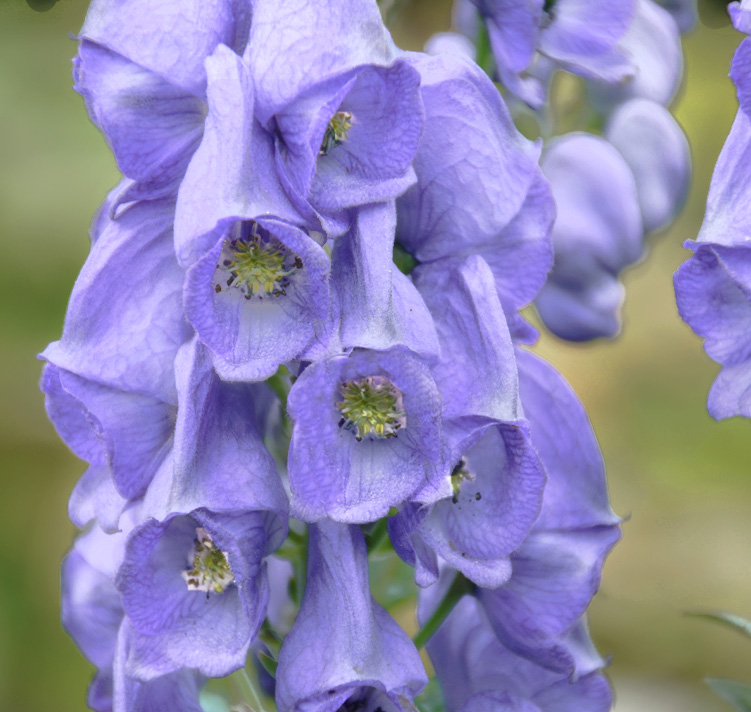
Aconitum carmichaelii
‘Spatlese’
SOFT BLUE MONKSHOOD
$5.50 AUD
Availability: In stock
- 1-9 pkts $5.00
- 10 pkts FREE
- Express post $12
Aconitum carmichaelii ‘Spatlese’
SOFT BLUE MONKSHOOD
Aconitum carmichaelii ‘Spatlese’ wows with spires of clear, pale blue hooded flowers, washed with violet.
Autumn spires of soft sky blue washed with violet
The colouring of Soft Blue Monkshood is bewitching.
Because the spires open as soft, clear sky blue, and then as the autumn marches on – the hooded blooms develop deeper blues and finally take on a blush of violet.
So you have all those lovely shades all at once, across the close packed autumn heads.
Loveliest of all autumn shows
Thus Aconitum carmichaelii ‘Spatlese’ is considered one of the beautiful of all autumn blooming perennials.
Plus the blue heads just sing against the mellow golds and yellows of other autumn foliage colours, as it is a late bloomer so coincides with the fall leaf colours.
Stunning – just when you think the garden treats are over
Soft Blue Monkshood makes a stunning late show – Just when you think all the garden treats are over, and the gloom of winter is looming – the sky blue spires steal your heart.
It blooms in early to late autumn, on strong 90-120cm spires.
Long blooming from early to late autumn
Aconitum carmichaelii ‘Spatlese’ is also considered one of the longest blooming of all the gorgeous Aconitums.
As it begins earlier in autumn than most others, but then carries on through its lovely colour transitions until late autumn.
Stunning cut flowers
All Aconitums provide excellent cut flowers, which last for ages in the vase.
Attractive foliage texture & shape
Aconitum foliage is also pretty, and gives an attractive textural contrast to the garden.
But because the leaves of Aconitum carmichaelii ‘Spatlese’ are particularly finely divided, and glossy, deep dark green, it is especially lovely.
After autumn blooming, the leaves form a thick groundcover for the rest of the year, before the soaring flower spires impress us all again in autumn.
Vivid autumn colours
The foliage enhances autumn’s spectacle, by turning rich butter yellow beneath the soft blue-violet blooms. Wow – what a contrast plant.
Easy growing & low maintenance
Aconitum carmichaelii ‘Spatlese’ is hardy, easy and low maintenance to grow.
So it can be planted in Sun to Part Shade.
Where it is extremely frost hardy, and does not require any special watering.
Just normal, average garden watering is sufficient.
Hardy long lived perennial
This is a very long-lived perennial, so you will enjoy many autumn shows.
Dense forest of flower spires and mat of foliage
The whole plant grows densely, forming a hardy perennial clump of foliage, low to the ground, except when in spire for the spectacular autumn flowering.
It will get fatter and denser each year, but never invades.
Low maintenance – pest & disease free
The only maintenance is to shear the spent flower spires back down to the ground in winter.
Plus Aconitum are rarely if ever plagued by any pests and diseases.
Rabbit & deer resistant
Fortunately Aconitums are not tempting to eat, with very bitter sap.
So rabbits, kangaroos and possums all leave it alone.
Caution: Wear gloves when dividing the plant, or cutting the flower spires, to protect yourself from the sap – all parts of plant are toxic, and should not be ingested.
SEED SOWING ADVICE:
Seeds can be sown directly in the garden in winter or early spring
OR
Sown in punnets indoors at any time when suitable temperatures can be provided (approx. 25°C).
Caution: Wear gloves when handling the seed, though there is little risk from the seed.
But it is wise to always treat all parts of Aconitum plants with respect.
Of course do not eat any part of an Aconitum.
(Even though there was a long history of medicinal use in earlier centuries – one can only hope the medieval pharmacists always got the dosage right!!!).
Sow indoors for optimum germination: First sow the seed in a punnet on the surface of good quality seed raising mix.
Then cover the seeds to a depth of 5cm. with sieved seed mix or vermiculite.
Now thoroughly moisten by standing the punnet in a shallow water bath, and allowing the moisture to percolate up to the surface of the mix from below. This will ensure the mix is thoroughly moist but not drenched.
Label the punnet with the name and date sown.
Now place the moist, sown punnet in a warm, well-lit position for 14 days (but not in any direct sunlight).
Temperatures of approx. 25°C are best for this pre-conditioning stage.
You can use a temperature controlled heat mat if you have one.
Continue to keep the punnet consistently moist by misting from a spray water bottle as required.
Covering the punnet with a clear plastic cover, plastic bag, or glass also helps to maintain consistent moisture and prevent drying out.
Pretend it is winter
For best germination, the seeds now benefit from a period of chilling (a pretend winter) after the warm pre-conditioning – so wrap the sown, moist punnet in cling-wrap or a plastic bag and place in fridge (not freezer) for 21 days.
Then take out, unwrap punnet, and keep moist in approx. 13-16C, in a well lit position again.
Seeds need good light to sprout, but the punnet should not be in any direct sunlight.
Seeds usually begin to germinate in approx. 30 days.
Or sow seeds directly in garden in autumn/winter and leave to get the required chilling from winter nature before germinating in the spring.
Seed Count: 20 seeds per packet approx.
(We always aim to exceed the stated count and give a generous serve)
*** Please note: All parts of Aconitum plants are toxic if eaten. Wear gloves when handling Aconitums.
Click here for Nursery Open Days & Open Gardens Information
https://www.gardivalia.com.au/open-gardens
Click here to go back to Seeds Shop
https://www.seedscape.net.au/shop/
Related products
-
 Add to WishlistAlready In WishlistAdd to Wishlist
 -
 Add to WishlistAlready In WishlistAdd to Wishlist
 -
 Add to WishlistAlready In WishlistAdd to Wishlist
 -
 All
AllDierama pulcherrimum
‘Rose Pink’
ROSE PINK FAIRY FISHING RODS
SALE: Buy 1 get 2 packs
$5.50 AUD Add to cartAdd to WishlistAlready In WishlistAdd to Wishlist