
Eryngium alpinum
‘Blue Star’
BLUE STAR FEATHERED SEA HOLLY
$5.50 AUD
Availability: In stock
- 1-9 pkts $5.00
- 10 pkts FREE
- Express post $12
Eryngium alpinum ‘Blue Star’
BLUE STAR FEATHERED SEA HOLLY
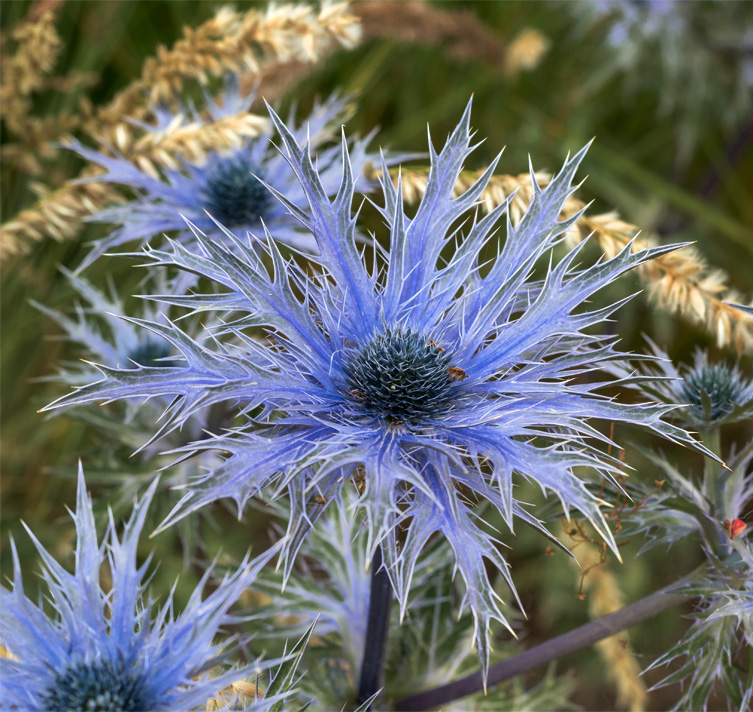
Eryngium alpinum ‘Blue Star’ is amongst the most showy of all Sea Hollies.
Rich-blue cones surrounded by large fringed blue ruffs
It bears deep-blue cones surrounded by large stars of fringed blue ruffs.
And well earns the common name of “Feathered Sea Holly”.
Spectacular feathers of flowers
The fringed feathers (bracts) surrounding the cones are truly spectacular – long, lacy and shining metallic blue.
As if they have been cut from blue aluminium sheets.
Full-on out-there gorgeous
There is nothing small or shy about this beautiful plant – it is full on, out-there gorgeous.
On shining silver-blue branching stems
Squadrons of feather flowers are held in large heads, on branching stems.
And even the stems have lovely silvery colouring.
Excellent fresh cut flowers
Eryngium alpinum ‘Blue Star’ is sensational as a floristry flower.
Prized for its unusual metallic deep-blue colours, and long vase life.
It is actually soft to the touch, despite the feathery bracts looking so prickly.
Exceptionally long vase life
Cut stems last for at least 10 days, and up to 16 days in a vase, particularly with fresh water.
Plus the stems are strong, without wilting.
And flowers and stems retain their marvellous metallic blue colour right through.
Super dried flowers
Eryngiums make amongst the very best dried flowers for permanent arrangements, wreaths etc.
As they retain all their colour and sheen when dried, and become very rigid.
Best cut for drying when the flowers are just opening.
Flowers float above a handsome foliage rosette
Branching heads of flowers float above a handsome foliage rosette of heart shaped leaves that sit flat to the ground.
The rosette stays evergreen in milder winter climates, and safely deciduous in very cold winter climates.
It is a long lived and very reliable perennial.
Thrives in heat
Eryngium alpinum ‘Blue Star’ revels in Full Sun and shrugs off heat.
Though it can also tolerate a little shade, as long as it is not damp shade.
Water wise & drought hardy
They are excellent plants for gardeners on a limited water budget.
Cope in poorer soils, including sandy soils
Eryngiums are best grown a little on the lean side, and do not need particularly rich soil.
Though they must have well-drained soils and will turn up their toes in any boggy conditions.
And they really appreciate some lime in all soils except those with a very high pH.
Frost hardy
Very frost hardy plants, happily coping down to approx. -15°C.
Salt resistant for coastal & windy gardens
And also happy growing in exposed, windy and coastal gardens.
The plant has good resistance to salty air, and the stems rigid in blowy conditions.
Feast for bees & pollinators
All sorts of insect pollinators, including native bees, honey bees, hover flies, and butterflies – are all in bliss amongst the blooms.
Because the cones (where the tiny real flowers are) are very rich in nectar.
Rabbit & deer resistant
Eryngiums are rated highly for their resistance to rabbits and deer.
They prefer softer, sweeter fodder.
A treasure for many years
Eryngium alpinum ‘Blue Star’ is a long-lived, evergreen perennial clump.
60cm. High in full summer heads on branching stems x 60cm. Wide flat rosette of heart-shaped leaves.
SEED SOWING ADVICE:
Sow at any time of year in a punnet indoors when suitable temperatures can be provided (18-22°C).
OR
Sow directly in the garden in winter-early spring.
Because these seeds need a period of cold for germination.
Sow indoors for optimum germination: First sow the seeds in a punnet/ individual plant tubes, on the surface of good quality seed raising mix.
Now cover the seeds lightly with mix – to the same diameter as the seed.
Thoroughly moisten the punnet by standing it in a shallow water-bath.
Allowing the moisture to percolate up to the surface of the mix from below.
And continue to keep moist by misting from a spray water bottle.
Covering the punnet with a plastic cover or bag will also help to maintain the necessary consistent moisture.
Temperatures of 18-22°C approx. are ideal at this part of the process.
Keep them warm and moist for 2-4 weeks.
Then cling wrap the moist punnet and place in the ridge (not freezer) for 4-6 weeks.
After 4-6 weeks of chilling – unwrap the punnet and place in an unheated, cool place.
Most seedlings should emerge in 5-30 days. But do not discard. Some seeds may come later.
Prick out the seedlings as soon as possible to larger pots, because these seedlings rapidly make long tap roots.
Grow on to garden size.
Seed Count: 10 seeds per pack approx.
(We always aim to give a generous serve and exceed the stated count).
Click here for Nursery Open Days & Open Gardens Information
https://www.gardivalia.com.au/open-gardens
Click here to go back to Seeds Shop
https://www.seedscape.net.au/shop/
Related products
-
 Add to WishlistAlready In WishlistAdd to Wishlist
-
 Add to WishlistAlready In WishlistAdd to Wishlist
-
 All
Dierama pulcherrimum
‘Rose Pink’
ROSE PINK FAIRY FISHING RODS
SALE: Buy 1 get 2 packs
$5.50 AUD Add to cartAdd to WishlistAlready In WishlistAdd to Wishlist -
 Add to WishlistAlready In WishlistAdd to Wishlist