

Amsonia
tabernaemontana
EASTERN BLUE STARS
$5.50 AUD
Availability: In stock
- 1-9 pkts $5.00
- 10 pkts FREE
- Express post $12
Amsonia tabernaemontana
EASTERN BLUE STARS
Amsonia tabernaemontana gives long value in the garden.
Clusters of ice-blue stars
Clustered heads of soft, ice-blue coloured stars, give the common name of “Eastern Blue Stars”.
The Eastern part comes because it is native down the whole length of the eastern half of the USA.
Long blooming from mid-spring into summer
This beautiful perennial gives so much value in the garden, with flowers, foliage, texture and plant structure.
The flower colour of ice-blue is rare in the plant world, and even more relished as the flowers keep coming on fresh stems from mid spring well into summer.
Then vivid foliage colours in autumn
Then in autumn the show continues as the fine foliage colours up to vivid golds and russet.
Plus the freshly emerging stems in spring also provide lovely colours and texture.
Fine willow-like leaves
Amsonia tabernaemontana clothes every stem with fine pointed foliage, resembling the leaves of a willow (hence another common name of “Willow Blue Star”).
A single clump produces many many stems, with each stem densely packed with willow-like leaves, and arranged right up the stems to the flowering tips.
In a halo of stems
Stems fan out like a graceful halo from a tightly growing base – so no wonder Amsonia tabernaemontana is considered a fine foliage, texture and structural feature in the garden.
As well as an outstanding bloomer.
A plant in full flight is approx. 75cm. high x 75cm. diameter.
Motion in the garden
The whole halo of fine stems and flowers sway and swirl gracefully in every breeze, so animating the garden.
This plant pleases on every level.
Next level interest in autumn
Then of course the whole halo of shape and texture steps to the next level with vivid autumn foliage colours.
Easily grown long-lived perennial
Amsonia tabernaemontana is an easily grown, graceful perennial clump.
It is long-lived and hardy, so will delight you for many years.
Plant in Full Sun to Part Shade.
Hardy in heat, dry, frost
With a native range across such a wide diversity of climates, from the cold north to the hot and humid south, Amsonia tabernaemontana easily adapts to a variety of conditions.
It is frost hardy down to at least -20°C, but can also cope with summer heat and humidity.
Water-wise & dry hardy
Once established it is a water-wise plant, that thrives on just average garden watering, and can get by with minimal additional watering, even during dry periods.
It is considered reasonably drought resistant if pushed.
Copes in a range of soils, including clay
Likewise it is able to cope in a wide range of soils, and is a treasure for gardeners on clay soil.
But can also do just as well in sandy soil or normal garden loam, as well as clay.
And it is serene in a wide range of soil pH, from acid to alkaline.
The only thing it dislikes is being permanently waterlogged.
Low maintenance
There is little if any work to do to keep clumps of Eastern Blue Star looking glamorous.
They do not need pruning, though you can tidy up by chopping back to the ground in winter, and thus clearing the way for the attractive new growth in spring.
(A trim back after flowering is only needed if they are grown in too much shade, making them unnaturally leggy).
They are almost never plagued by any pests or diseases.
Rabbit & deer resistant
Rabbits and deer are both common in the native habitat of Amsonia, so the plant has developed natural defences to being chewed.
It has a milky sap, like Euphorbias, that stings the lips (wear gloves if pruning).
Attracts pollinators
While it does everything it knows to be a honeypot for bees, butterflies, pollinators and nectar sipping birds, with flowers rich in nectar.
SEED SOWING ADVICE: Warm-cool-warm
Sow seeds of Amsonia tabernaemontana at any time indoors whenever suitable temperatures can be provided (20-22°C).
OR
Sow directly in the garden in autumn and winter.
First boil some water and leave to cool down a little.
Then place seeds in a glass of warm water at approx. 20C.
And leave to soak for 24 hours before sowing.
Now sow the seeds on the surface of good quality seed raising mix in a punnet.
And pat gently into surface to ensure good contact.
But do not cover with mix, as these seeds need light to germinate.
Give a “pretend winter”
Place in a cool, well-lit position at around 20-22°C approx. for 3-4 weeks (never in any direct sunlight as this will dry out the seeds too much).
You can use a heat mat if you have one to maintain warm temperatures for this pre-conditioning.
(Some of the seeds may germinate during this pre-conditioning warm time – so prick out any early seedlings that have germinated, before giving the moist-cold treatment period.)
Then wrap the moist, sown punnet in cling-wrap and leave in fridge (not freezer) for 3-4 weeks.
Now remove, unwrap, moisten again in the water bath, and return the punnet to the warm, well-lit place at temperatures around 20-22°C for germination.
Seedlings begin emerging in approx. 30 days.
Prick out seedlings and pot on as they appear.
But do not discard the punnet as seeds will likely continue to germinate over a period (staggered germination is a natural defence of this plant to give the babies a sporting chance).
Seed Count: 5 seeds per pack (Seeds of this unusual beauty are rarely available).
Click here for Nursery Open Days & Open Gardens Information
https://www.gardivalia.com.au/open-gardens
Click here to go back to Seeds Shop
https://www.seedscape.net.au/shop/
Related products
-
 Add to WishlistAlready In WishlistAdd to Wishlist
 -
 Add to WishlistAlready In WishlistAdd to Wishlist
 -
 All
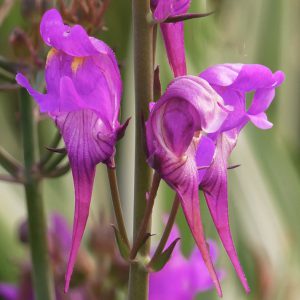
AllLinaria triornithophora
‘Three Birds Flying’
3 BUDGIES
SALE: Buy 1 get 2 packs
$5.50 Add to cartAdd to WishlistAlready In WishlistAdd to Wishlist -
 Add to WishlistAlready In WishlistAdd to Wishlist