
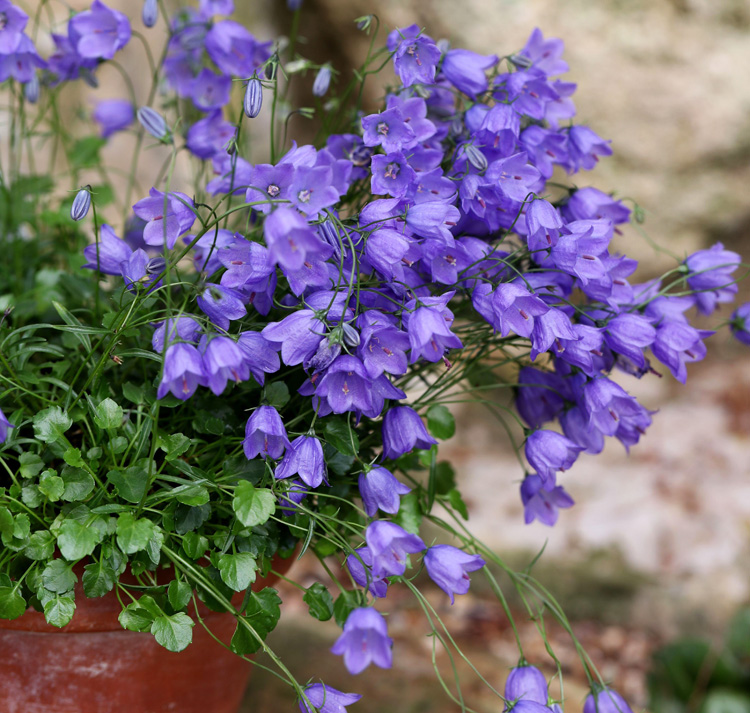
Campanula cochleariifolia ‘Blue Baby’
BLUE FAIRY THIMBLES
$5.00 AUD
Availability: In stock
- 1-9 pkts $5.00
- 10 pkts FREE
- Express post $12
Campanula cochleariifolia ‘Blue Baby’
BLUE FAIRY THIMBLES
Campanula cochleariifolia ‘Blue Baby’, covers itself with enchanting rich blue bells, with a faint blush of lavender.
Rich blue nodding thimbles faintly blushed with lavender
‘Blue Baby’ is a prolific bloomer, and each plant forms a little, rounded cloud of bobbing thimbles – like a flock of fairy’s thimbles thrown in the air.
Dancing like a cloud of fairy’s thimbles
So the thimble flowers on wiry stems dance about in even the faintest breeze, frolicking in a frenzy of thimbles tossed above the flat foliage carpet.
Compact mat of dense ground-hugging foliage
Campanula cochleariifolia ‘Blue Baby’ is perfect for edging the front of a garden bed, filling and spilling over a decorative pot, or making a low carpet of groundcover.
Perfect to edge a garden, fill a pot or mass plant for groundcover
As the foliage forms a dense, ground-hugging, evergreen mat approx. 30cm. wide.
With the flowers hovering just 15cm. above.
Each low clump will cover a diameter of approx. 20-30cm. wide.
So plant a row to form an edge or mass plant make a carpet.
Very pretty spilling over an edge
They will spill over an edge very prettily – like a cascade.
Neat and never invasive as a groundcover or edge
They are neat and never invasive when mass planted, and are too low to ever smother companion plants.
Easy to grow & low care
Campanula cochleariifolia ‘Blue Baby’ is easy to grow and low maintenance.
It is virtually disease and pest free, and rarely needs any pruning.
Even the wiry flower stems are self cleaning after a long spring-summer blooming season.
Rabbit & deer resistant
‘Blue Baby’ is not high on the menu list for rabbits and deer, though in a famine they may have a nibble.
Baby Blue Bells made for bees & pollinators
While both native and honey-bees are attracted to the sky-blue of the bells to feast on all the nectar inside.
Plant in Part Shade or Sunny sites
Campanula cochleariifolia ‘Blue Baby’ grows happily and easily in a range of sites – from Dappled Shade to Full Sun.
Though in hot districts it does better in Dappled Shade or where it gets some shade in the afternoon – making it perfect to plant as a groundcover or edge under taller plants.
In cooler climates it can take full sun.
Happily grows in a wide range of soils
‘Blue Baby’ will bob along in a wide range of soils – from acid to alkaline soil pH, and from sandy to garden loam.
They do relish lime (making them ideal underplanting for roses) – so in acid soils, dress with some Dolomite Lime when you do the roses.
Only needs average garden water
Campanula cochleariifolia ‘Blue Baby’ is not a water-guzzler.
So in garden loam it requires only normal, average garden watering, and no special attention.
Though it will need more regular watering in very sandy soils.
It does not enjoy being water-logged, or planted in poorly drained soil.
Very frost hardy
Easy-going little ‘Blue Baby’ is very frost hardy, and can tolerate temperatures down to below -20°C.
SEED SOWING ADVICE: QUICK & EASY
Sow Campanula cochleariifolia ‘Blue Baby’ seeds at any time when suitable temperatures can be provided (18-22°C).
First sow the seeds on the surface of good quality seed raising mix.
Do not cover the seeds, but just gently pat the seeds on the surface of the mix to ensure good contact.
Because these seeds need light to germinate.
Now thoroughly moisten the sown punnet by standing it in a shallow water bath.
And allow the moisture to percolate up to the surface of the mix from below.
Then cover the seed punnet with clear plastic cover to help maintain consistent moisture.
And place in a warm, well-lit position (but NOT in direct sunlight).
Continue to keep the punnet consistently moist by misting from a spray water-bottle.
Temperatures of 18-22°C approx. are ideal for rapid and optimum germination.
You can use a heat mat if you have one, but it is not essential, as these seeds are quick and easy to germinate.
Germination occurs in approx. 14-28 days, but can begin as early as 7 days.
It is normal for these seeds to stagger their germination (for safety) – so do not discard the punnet too quickly, as more seeds will likely come later.
Pot on seedlings once two sets of leaves appear, as they appear.
Then harden off and mature before finally planting out in the garden.
Seed Count; 80 seeds per pack approx.
(We always aim to exceed the stated seed count, and give a generous serve).
Click here for Open Gardens Information
https://www.gardivalia.com.au/open-gardens
Click here to go back to Seeds Shop
https://www.seedscape.net.au/shop/
Related products
-
 Add to WishlistAlready In WishlistAdd to Wishlist
 -
 Add to WishlistAlready In WishlistAdd to Wishlist
 -
 Add to WishlistAlready In WishlistAdd to Wishlist
 -
 Add to WishlistAlready In WishlistAdd to Wishlist