
Eryngium
bourgatii
MEDITERRANEAN SEA HOLLY
$5.50 AUD
Availability: In stock
- 1-9 pkts $5.00
- 10 pkts FREE
- Express post $12
Eryngium bourgatii
MEDITERRANEAN SEA HOLLY
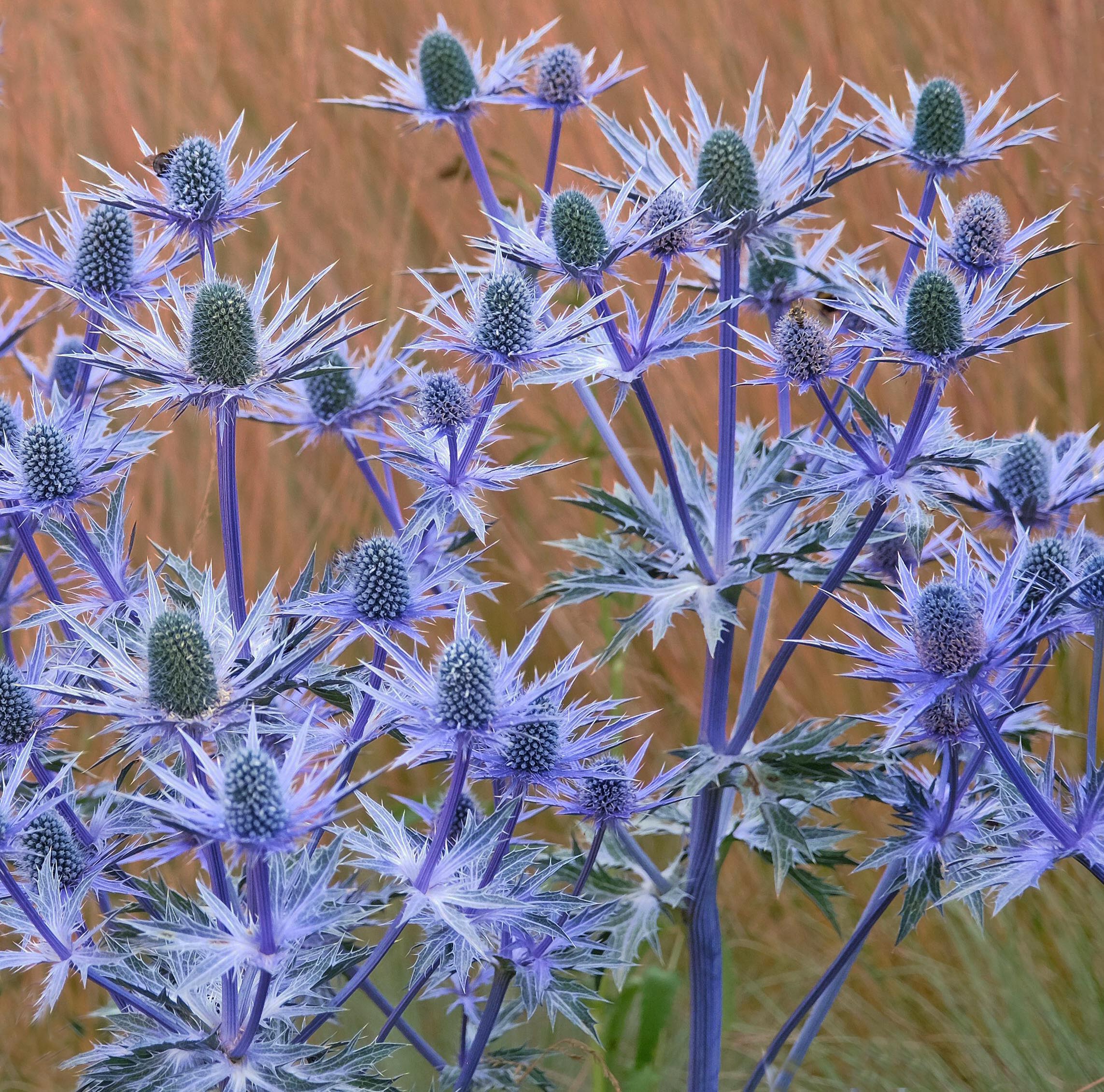
Eryngium bourgatii is a beauty show winner for both flowers and foliage.
Blooms in large branching heads as a cloud of violet-blue
With a mass of blooms flying in large branching heads on deep blue metallic stems.
Flower heads float clear above a very attractive low foliage mound.
Violet-blue cones & ruffs plus deep blue stems
The cloud of violet-blue cones and feathery ruffs, are all held on an architectural structure of deep blue stems. aking Eryngium bourgatii a great sight in full flower.
35cm. High approx. in flower x 30cm. Wide approx. compact foliage mound.
Beautiful silver laced foliage – stars in the garden
Blooms above a neat rosette of deeply lobed, dark green leaves, heavily spangled with silver lacing.
Foliage is so striking it is a star act in the garden by itself , even without the flowers.
Tough as old boots in the dry garden
Eryngiums revel in the hottest, driest, most exposed, sunniest position you have.
Expert in sizzling summers & frosty winters
And Eryngium bourgatii is native to hot, dry, stony where the summers sizzle and the winters are sharply cold.
It is after all native to Morocco, Lebanon and Spain – so it knows all about heat and dry conditions.
Dry summer heat & drought resistant
And of course well adapted to long periods of summer heat and dry, and has very low water needs.
Very water-wise
Eryngium bourgatii accepts dry conditions as normal, and is therefore very drought resistant.
Eryngiums invented “drought hardy”
And in fact, if you give Mediterranean Sea Holly too much water, it will probably turn up it’s toes.
Placing it right up there with Sedums, as being highly recommended for water conscious gardeners.
Perfect for sea-side gardens
And particularly recommended for seaside gardeners because it can also happily tolerate some salt in the air and very windy positions.
(Scroll down to GROWING section for more details & tips).
Long lasting fresh cut flowers
Eryngiums can be compared to Everlastings in texture, as they are firm to the touch.
So they make extremely long lasting vase flowers when they are cut fresh.
Perfect violet-blue dry flowers
And for dried arrangements you just hang the flower heads upside down until fully dry, and they retain their marvellous violet-blue colours.
Bees & pollinators love them
Cones of Eryngium are very rich in nectar – so any flying pollinators become intoxicated with them.
Native bees, honeybees, butterflies and hoverflies – all the best pollinators can’t get enough of them.
Feed for birds in winter
Many gardeners like to leave the dried seed heads for finches and other small seed eating birds over winter.
The dried branches of seed heads certainly look very attractive in the winter garden rimmed with frost.
Rabbits & deer don’t like them
Happily – rabbits and deer tend not to touch Eryngiums because of their tough, dry, metallic texture.
The pests enjoy more tender and juicy fodder.
SEED SOWING ADVICE: QUICK & EASY
Eryngium bourgatii
Sow seeds at any time of year in a punnet indoors, whenever suitable temperatures can be provided (18-22°C).
OR
Sow directly in the garden during winter-early spring. Seeds need a period of cold for best germination.
Sow indoors for maximum germination & early plants: First sow the seeds in a punnet on the surface of good quality seed raising mix.
Then press the seeds gently into the surface of the mix to ensure good contact.
Now barely cover the seeds with sieved mix / grit / washed sand.
Then place the sown, moist punnet in a warm, well-lit spot (not in direct sunlight).
Temperatures of 18-22°C are ideal for rapid and optimum germination.
So you can use a temperature-controlled heat mat if you have one to encourage rapid germination, but it is not essential. A window-sill or well-lit corner is also fine.
Seeds germinate in approx. 5-30 days.
However if the seeds are shy to germinate after 4 weeks. Then cling wrap the moist, sown punnet and place in fridge (not freezer) for 4-6 weeks.
Then remove, unwrap, re-moisten, and return the sown punnet to a well-lit warm place.
Prick out as seedlings as soon as possible after germination, and move into deeper pots, as the young plants quickly form long tap roots (which of course helps them to forage for water in a dry climate).
Seed Count: 15 seeds per pack approx.
(We always aim to exceed the stated seed count, and give a generous serve).
GROWING: Eyngium bourgatii
– Height with flowers: Big, airy summer flower heads come up in feathers to 35cm approx.
– Width: Evergreen clump of silver laced foliage to a diameter of approx. 30cm.
– Position: Eryngium bourgatii revels in the hottest, driest, most exposed, windiest and sunniest position you have.
It will tolerate just a little shade, as long as it is well aired. But under no circumstances should it be damp shade.
All Eryngium are ideal for coastal and seaside gardens, where they tolerate salt spray well.
Eryngiums invented “Drought Hardy”
– Soil: Eryngiums adore anything that drains perfectly.
So sandy, rocky, gravel soils are just their thing.
They will certainly also thrive in average garden loam, as long as they are not overwatered.
But kiss them goodbye in heavy, wet, or clay soils.
They are not a bit fussy about soil pH, and so will live happily in soils on either the acid or the alkaline (lime) side of neutral.
And it is a mistake to over fertilize them, as they grow and flower best when kept on lean rations.
Bliss for water challenged gardeners
– Water-wise: Eryngiums have very low water needs. They accept dry conditions as normal, and are very drought resistant. In fact if you give them too much water they will probably turn up their toes.
– Frost: Eryngiums are bomb proof in frost, and can blissfully ignore severe frost down to well below -20C.
Handsome & architectural
– Growth: Evergreen perennial that remains all year as a ground hugging rosette of marbled silver leaves.
Then in the summer it erupts up with clouds of silver-blue-green cones, on large branching heads. Magic.
– Fragrance: None, but Eryngiums have so many other highly desirable qualities we can forgive one little oversight.
Bees love them & rabbits hate
– Beneficial for wildlife: Bees and other useful pollinators work them very happily for abundant pollen and nectar, oblivious to any prickles.
– Low Care: Eryngiums are very low maintenance, with the only work being to cut the finished flower branches down at the end of autumn, though many gardeners like to leave the dried seed heads for finches and other small seed eating birds over winter. The dried branches of seed heads certainly look very attractive rimmed with frost.
– Deer & Rabbit resistant: I dare the pests to take a gobble and get a mouthful of prickles. But they are too smart, and don’t touch them
– Origin: Hot, dry and stony places mainly in Morocco, Lebanon and Spain.
Click here for Nursery Open Days & Open Gardens Information
https://www.gardivalia.com.au/open-gardens
Click here to go back to Seeds Shop
https://www.seedscape.net.au/shop/
Related products
-
 Add to WishlistAlready In WishlistAdd to Wishlist
-
 Add to WishlistAlready In WishlistAdd to Wishlist
-
 Add to WishlistAlready In WishlistAdd to Wishlist
-
 Add to WishlistAlready In WishlistAdd to Wishlist