
Ferula communis ssp. cardonae
GIANT SICILIAN FENNEL
$5.50 AUD
Availability: In stock
- 1-9 pkts $5.00
- 10 pkts FREE
- Express post $12
Ferula communis ssp. cardonae
GIANT SICILIAN FENNEL
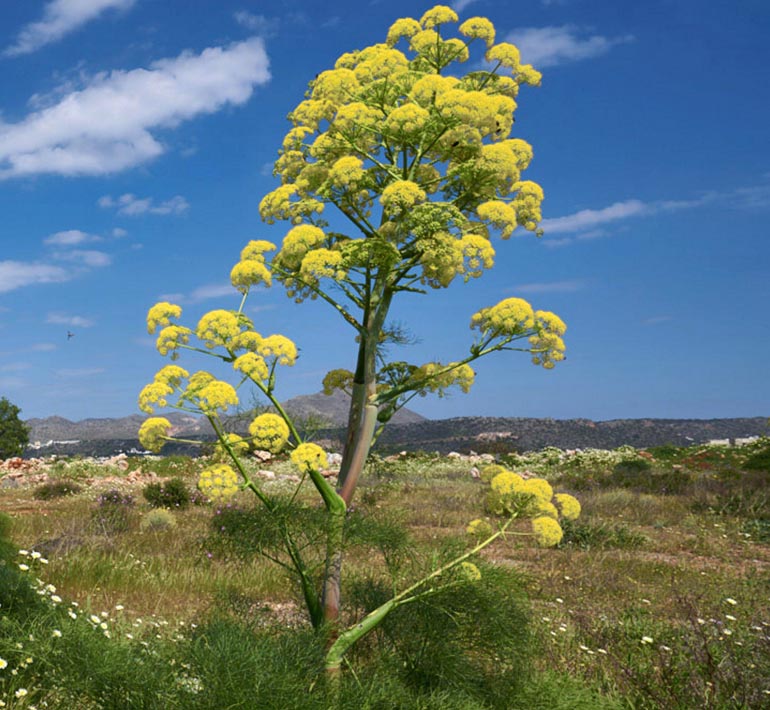
Ferula communis ssp. cardonae – The Giant Sicilian Fennel – is a mighty plant in every sense of the word.
First a mound of feathery filigree fine foliage
First the foliage mound is lovely in winter and spring.
A froth of finest feathery, filigree fine, cut foliage – in cool blue-green colour – forms a mound 60cm. high approx.
If winter & spring foliage was all it did – it would be enough
It is the perfect textural companion for all the riotous colour of spring bulbs and flowers.
And a lovely foliage feature in winter.
Then in summer – it shoots for the sky
Then in spring a stout, fibrous, angular stem – thick as a broomstick – begins to rise with breathtaking speed and great architectural structure.
This is a plant that goes from 0 to 100 and into flower while you not looking.
Basketballs of citrus-yellow soaring in the spring sky
So you turn around and there is a branching head of large, citrus-yellow basketballs, made up of tiny flowers.
Soaring in the spring sky some 1-3 metres.
Atop this marvellous, architectural stem.
An interesting piece of architecture
While you can never call Ferula communis ssp. cardonae pretty – it is striking and architectural in flower.
While the winter and spring foliage mound, without the soaring flowers, is really lovely.
Team with summer Cosmos or Queen Anne’s Lace
Then by mid-summer the whole show is over – the plant goes summer dormant – leaving room for a summer crop sowing of Cosmos or Ammi (Queen Anne’s Lace) etc.
But don’t worry – the filigree foliage mound will be back doing duty next winter.
Giant Sicilian fennel – a very useful plant
Ferula communis ssp. cardonae is NOT edible Fennel (though a relative).
But it has many other traditional uses on Sicily and the Balearic Islands where it grows native and wild.
Rods for discipline, torches & tomatoes
Dried stems were used for
* Making whips for lazy donkeys, and rods to discipline naughty boys.
* Making fire torches and candles, as the dried stems are hollow, filled with a fibrous inner which burns slowly.
* Obviously for staking tomatoes and building grapevine trellis.
Thrives in heat & dry
As a native of the rocky hillsides of Sicily – no prizes for guessing this plant absolutely loves long, hot, dry summers and some rain in winter.
Relishes rocky, gravel & sandy soils
And no prizes for saying it thrives on hot, exposed, rocky hillsides, seaside cliffs and beaches on Sicily – with no human help.
Supremely water-wise & drought hardy
As the plant grows lushly in winter and spring, then retires away for all the hot, dry months – it is supremely water saving.
Ferula communis ssp. cardonae develops a deep, strong tap root which sustains it through dry times.
Favourite for bees & butterflies
Native and honey bees, butterflies and night flying moths, and even beetles all adore sipping nectar from the towering basketballs of flowers..
The stems are strong enough to support all comers.
Rabbit & deer resistant
Rabbits and deer leave it well alone.
SEED SOWING ADVICE: QUICK & EASY
Sow seeds of Ferula communis ssp. cardonae at any time indoors in small pots, whenever suitable temperatures can be provided (10-15°C).
OR
Sow directly in garden from late autumn, through winter, to very early spring.
Bury individually 1cm. deep.
Tips for Pre-sowing treatment that helps improve germination:
1. Seeds of Ferula communis ssp. cardonae have a hard outer coating.
It helps improve and speed up germination if the hard coating is first scratched, so the seed can take water in.
So first gently rub the seeds between 2 sheets of sandpaper to roughen the surface.
2. Then soak the seeds in a glass of warm (previously boiled) water, and leave to stand overnight.
Sow indoors for quick plants: First sow the seeds in small pots of good quality seed raising mix.
Then cover with sieved mix to a depth of 1cm.
Young plants of Ferula quickly make a strong, long tap root – so using deep seedling tubes, like forestry tubes, is an advantage.
Now thoroughly moisten the sown pots by standing them in a shallow water bath.
And allowing the moisture to percolate up to the surface of the mix from below.
Then place the moist, sown pots in a cool, well-lit position (not in any direct sunlight).
Temperatures of 10-15°C approx. are best for rapid and optimum germination.
It is essential to choose a position that remains cool, and the seeds do not mind cold, frosty nights.
*** Please note temperatures above 20°C will throw the seeds back into dormancy until next winter’s cool conditions.
*** Temperatures between 15-20°C will reduce germination rates until next winter’s cool temperatures.
Now continue to keep moist by placing a plastic lid or bag over the sown pots, and keep misting the mix surface with a spray water bottle when required, to keep the mix consistently moist.
Seedlings begin to emerge in approx. 14-30 days.
It is important to get the young seedlings planted out into the ground, or bigger pots, as soon as possible after the first set of true leaves develop.
Because of the quickly lengthening, long, strong tap root.
Transplant with as little disturbance to the root/s as possible.
Seed Count: 10 large seeds per pack approx.
(We always aim to exceed the stated seed count, and give a generous serve).
Click here for Nursery Open Days & Open Gardens Information
https://www.gardivalia.com.au/open-gardens
Click here to go back to Seeds Shop
https://www.seedscape.net.au/shop/
Related products
-
 Add to WishlistAlready In WishlistAdd to Wishlist
 -
 Add to WishlistAlready In WishlistAdd to Wishlist
 -
 Add to WishlistAlready In WishlistAdd to Wishlist
 -
 All
AllDierama pulcherrimum
‘Rose Pink’
ROSE PINK FAIRY FISHING RODS
SALE: Buy 1 get 2 packs
$5.50 AUD Add to cartAdd to WishlistAlready In WishlistAdd to Wishlist