
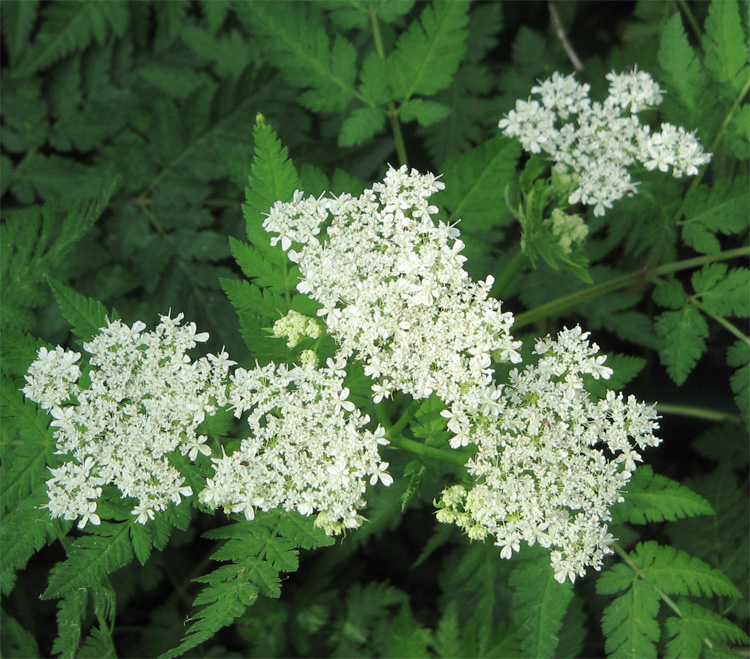
Myrrhis odorata
SWEET CICELY
$5.50 AUD
Availability: In stock
- 1-9 pkts $5.00
- 10 pkts FREE
- Express post $12
Myrrhis odorata
SWEET CICELY
Myrrhis odorata is attractive as well as useful, and SUPERBLY FRAGRANT.
Renowned for exquisite fragrance
This lovely plant is renowned for its exquisite fragrance, hence the botanical name of Myrrhis odorata.
The deep green, fern-like leaves are deeply divided, and smell of aniseed when crushed.
Ideal groundcover or edge – where can be brushed or crushed for fragrance
So it is ideal as a groundcover planted beside a path where it can give of it’s fragrance every time you tread on or brush it.
The plants grow as a dense groundcover, and flowering to a height of 80-90cm.
White flower heads spring into summer
And heads of tiny white flowers appear from spring to early summer.
Early treat for gardeners & bees
Myrrhis odorata is one of the fist aromatic and herbal plants to begin flowering in spring – so it is an early treat for gardeners and bees.
Soft ferny, very pretty foliage
Leaves are finely dissected, ferny, with a soft velvety texture and a silver sheen.
Gorgeous foliage plant, even without the exquisite fragrance and pretty white flowers.
Hardy, easy to grow groundcover
Grow it in either Partial Sun, or Shade in most districts.
Though it can take Full Sun in cool and elevated districts.
Prized as an easy groundcover for shade
But it is highly prized as a low maintenance groundcover for shaded areas.
Lush groundcover under trees & shrubs
Myrrhis odorata is perfect for carpeting under trees & shrubs where you want low maintenance, or also trailing from a decorative tub.
Grows approx. 60cm. tall when in full flower during spring and summer (shorter rest of the year when just in foliage) x 1m diameter.
Sweet Cecily is also an edible herb
The entire plant is edible – leaves, stems, flowers and roots.
So use the foliage and flowers in any dishes where you need a sweet, mild aniseed or fennel flavour.
Such as herbal teas, drinks, salads, soups, fish sauces, vegetable dishes and desserts.
So versatile in the kitchen
Cook the leaves like spinach; or add to vegetable and chicken soups; chop finely into scrambled eggs or fresh into a salad.
Edible foliage flowers roots & seeds
The white flower heads also make a very pretty and edible garnish for drinks, salads, meat dishes etc.
While the roots are traditionally harvested and cooked like a parsnip – yummy roasted – grated raw into salads – or steamed and mashed.
Dried seeds are used in fruit pies or just chewed as a snack.
For those that like a tipple
Myrrhis odorata is an essential ingredient in Chartreuse liqueur – made by the Carthusian monks for centuries.
It also makes a fine flavouring for botanical gins and vodka.
It is also used in Aquavit – a drink widely promoted as a digestive after a rich meal.
Plant of myth & medicine
Gardeners have loved and used Sweet Cicely for many centuries.
So it has acquired a bevy of charming common names – Roman Plant (the Romans loved it), Cow Chervil (cows love it); Anise Root; Sweet Chervil; Sweet Fern (lovely ferny foliage) and Myrrh Plant (lovely scent); Shepherd’s Needle; and Sweet Cus (no idea why).
The botanical name of “Myrrhis” comes from Greek – where it means “scented like myrrh”; while “odorata” obviously means “fragrant”.
Natural sweetener for diabetics
It has long been used in traditional village medicine to treat coughs and to stimulate the appetite, and as a natural sweetener for diabetics.
Rich in nectar – bee & pollinator magnet
Beekeepers adore a patch of Sweet Cecily, as honey made by foraging bees has a special tang.
Native bees, honeybees, as well as our other useful pollinating insects – just cant get enough of it.
Tough in a wide range of soil & water-wise
Plants enjoy a soil pH from very acid to neutral, to slightly alkaline. But it is not suitable for limestone country.
It likes well drained soil but is not fussy about the type.
It is not a thirsty plant, requiring only average garden watering during dry times.
Very frost hardy
Good old Sweet Cicely does not blink in frosts down to -20°C. That is one tough plant.
SEED SOWING ADVICE:
Seeds of Myrrhis odorata are easily grown when sown directly outdoors in autumn, especially in districts that have cold winters.
In mild winter areas it is better to sow indoors with cold treatment.
OR
Sow seeds indoors when suitable temperatures can be provided (18-22°C).
You can use room temperature or a heat mat to maintain temperature, after a period of cold treatment.
The seeds then germinate freely after cold winter temperatures.
Sow direct into the garden or indoors
Sowing outdoors: First, in autumn, prepare a seed bed by laying a bed good quality seed raising mix where you want them to grow.
The seeds are large so you can place them where you want them.
Then cover to a depth of 5mm.
Keep a check on the seed raising mix, to ensure it doesn’t dry out.
If needed, transplant the young plants into their final positions in the following spring.
Sow indoors for optimum germination: First sow the seeds in a punnet or in individual small pots, on the surface of good quality seed raising mix.
Gently pat the seeds to the surface of the mix to ensure good contact with the mix.
Then cover with sieved mix or fine vermiculite to a depth of approx. 5mm.
Now thoroughly moisten by standing the punnet/pots in a shallow water bath and allowing the moisture to percolate up to the surface of the mix from below. Mist surface with a spray water bottle ensure thoroughly moist.
Give them the cold treatment
TIP – Cold treatment: Then wrap the punnet/pots in cling-wrap/plastic bag, and place in the fridge (not freezer) for 6-8 weeks.
This mimics the action of winter and helps break down the seeds natural dormancy.
TIP – If fridge space is scarce – Tip for space saving: You can do the “pretend winter” chilling by mixing the seeds with a small amount of moist seed raising mix or vermiculite in a small plastic bag, then sow the seeds in the punnet or individual small pots once they are out of the fridge.
Once out of the fridge and sown.
Resoak in the shallow water bath to ensure mix is thoroughly moist.
Now place the punnet/pots in a warm, well-lit position (not in any direct sunlight).
Temperatures of approx. 18-22°C are best for optimum germination.
You can use a heat mat if you have one to maintain consistent temperature.
Continue to keep consistently moist by misting from a spray water-bottle.
Seeds will begin to germinate in approx. 40 days.
But patience – do not discard the punnet, as some seeds will come later.
This is natural trick of the plant to give the new babies a better sporting chance.
Prick out and pot on seeds as they emerge.
Harden up ready to place out in the garden.
Seed Count: 5 seeds per pack approx.
(We always aim to exceed the stated seed count and give a generous serve).
Click here for Nursery Open Days & Open Gardens Information
https://www.gardivalia.com.au/open-gardens
Click here to go back to Seeds Shop
https://www.seedscape.net.au/shop/
Related products
-
 Add to WishlistAlready In WishlistAdd to Wishlist
 -
 Add to WishlistAlready In WishlistAdd to Wishlist
 -
 Add to WishlistAlready In WishlistAdd to Wishlist
 -
 Add to WishlistAlready In WishlistAdd to Wishlist