

Peucedanum
verticillare
GIANT MILK FENNEL
$5.50 AUD
Availability: In stock
- 1-9 pkts $5.00
- 10 pkts FREE
- Express post $12
Peucedanum verticillare
GIANT MILK FENNEL
Peucedanum verticillare impresses with giant lacy heads of cream & green, above umbrellas of decorative foliage.
Giant lacy white heads of cream & green
The flower heads of Peucedanum verticillare are really impressive – huge; and lots of them.
Thrilling misty effect
Each huge head is made up of thousands of tiny white flowers.
Looking like skyrockets exploding
Large, lacy and delicately coloured with a blush of green over the cream lace.
Queen Anne’s Lace on steroids
So if you love the misty effect of Queen Anne’s Lace – then you will be thrilled by the haze of these giant beauties.
This is Queen Anne’s Lace on steroids.
As they tower 1.5m+ in the air
Peucedanum verticillare is perfect for making a big effect the back of the border, reaching a flowering height of at least 1.5m. by midsummer.
Or fabulous for drifting amongst trees in the background.
Intricate architecture 0f dramatic ruby red stems
The architecture of the stout trunks and mass of branching flower stems is also dramatic.
As they are coloured deep ruby-red, maturing to almost black later in the summer.
Fabulous misty heads by mid-summer & on into autumn
Flowering continues from mid-summer, on into autumn.
Followed by late autumn purple & white seed heads
Even the late autumn seed heads are dramatic and very decorative.
Huge gift for florists
Florists are beside themselves for a supply of cut flower heads, and cut seed heads of Giant Milk Fennel.
Umbrellas of decorative foliage
Beneath are umbrellas of frosty blue-foliage – also fine and very decorative – like blue tinted Parsley (but not edible).
A WOW in spring
The unfurling leaves and stems in spring are particularly lovely with pink tints on blue, and ruby trunks.
But a fennel it aint
But a fennel it ain’t. And Parsley it ain’t.
So it is not an edible herb, though it was used in traditional village medicine as a diuretic (definitely not recommended today – it is not edible).
But a great garden and vase decoration instead.
Tough & hardy Italian
Peucedanum verticillare hails from stony slopes and woodlands in Italy, and further afield in southern Europe.
Takes naturally to hot, dry summers & cold, frosty winters
So it is well adapted for long, hot, dry summers; and sharp cold, frosty winters.
Prefers shade & handy feature in the company of trees
Peucedanum verticillare can be planted in Sun or Shade.
It naturally prefers the shade as a woodland dweller, but can be grown in Full Sun in cooler districts.
Tolerates dry shade well
And it is particularly suitable to plant near trees and shrubs because it can tolerate Dry Shade so well.
Where it happily foams away with it’s lacy heads with little further attention from us.
Water-wise
Peucedanum verticillare is drought tolerant once established and is therefore a very water-wise plant.
Tolerates a wide range of soils
Easy going Peucedanum verticillare makes a go of it in just about any soil – from sandy; through rocky; to clay.
As long as it is not permanently waterlogged.
Tolerates both acid and lime soil pH.
Tough easy grower & low maintenance
Peucedanum verticillare is a hardy, short lived perennial, that self-seeds for future generations.
Happily it self-sows in garden but is not a nuisance. And any unwanted offspring are easy to weed out.
So it is a tough, easy grower, and low maintenance plant.
1.5+ metres. High with beautiful umbrels of lacy cream and green flowers x 80cm Wide of blue-green fennel-like foliage.
SEED SOWING ADVICE: Warm-cold-warm: EASY
Sow indoors at any time, whenever suitable temperatures can be given (18-20°C).
OR
Sow in the garden in autumn.
To allow the cold of winter to condition the seeds for spring germination.
Sow indoors for optimum germination & early plants: First sow the seeds in a punnet, on surface of good quality seed raising mix.
Then gently pat the seeds to the surface of the mix to ensure good contact.
And cover only lightly with 2mm of sieved mix/fine grit/fine vermiculite.
Now thoroughly moisten the sown punnet by standing it in a shallow water bath, and allowing the moisture to percolate up to the surface of the mix from below.
Then place the sown, moist punnet in a warm, well-lit position (NOT in any direct sunlight – as this will dry the seeds out and prevent germination).
And you can use a heat mat if you have one, but a window sill or well lit corner will do just as well.
At temperatures of 18-20°C. for 2-4 weeks of pre-conditioning.
Continue to keep the mix consistently moist by misting regularly from a spray water bottle.
And cover the punnet with a plastic lid or bag, to help retain the necessary consistent moisture between mistings.
Then wrap moist punnet in cling wrap & place in fridge (not freezer) for 4- 6 weeks.
Unwrap & return to well-lit position at 12-15°C. Keep moist. Seedlings emerge in 14-28 days approx.
Prick out quicly, as soon as seedlings develop their first set of true leaves.
Pot up and grow on for garden planting.
Seed Count: 30 seeds per pack approx.
(We always aim to exceed the stated seed count and give a generous serve).
Click here for Nursery Open Days & Open Gardens Information
https://www.gardivalia.com.au/open-gardens
Click here to go back to Seeds Shop
https://www.seedscape.net.au/shop/
Related products
-
 Add to WishlistAlready In WishlistAdd to Wishlist
-
 All
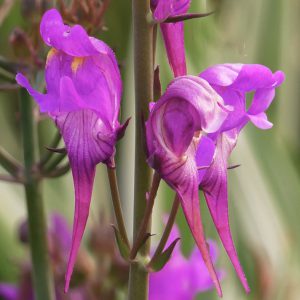
Linaria triornithophora
‘Three Birds Flying’
3 BUDGIES
SALE: Buy 1 get 2 packs
$5.50 Add to cartAdd to WishlistAlready In WishlistAdd to Wishlist -
 Add to WishlistAlready In WishlistAdd to Wishlist
-
 Add to WishlistAlready In WishlistAdd to Wishlist