
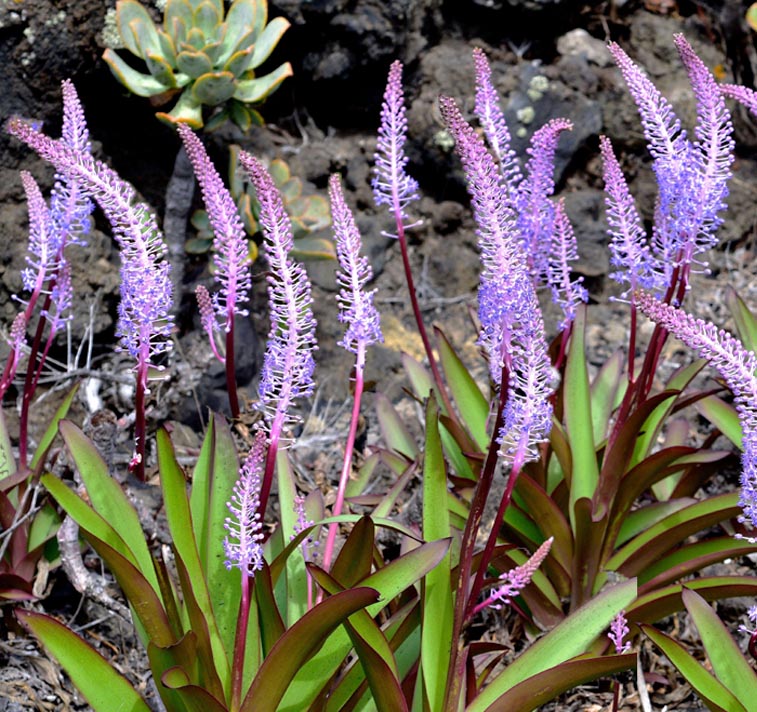
Scilla latifolia
GIANT SQUILLS
$5.50 AUD
Availability: In stock
- 1-9 pkts $5.00
- 10 pkts FREE
- Express post $12
Scilla latifolia
GIANT SQUILLS
Syn. Autonoe latifolia
Autumn blooming Scilla latifolia is a breathtaking sight.
And a whole group of them sweeps you off your feet in autumn.
Spires bearing hundreds of intense blue-violet stars
Blooming with long, airy towering spires, bearing hundreds of intense blue-violet stars on cobweb fine filaments.
I thought no spires could ever be as beautiful as those of a Foxtail Lily, but Scilla latifolia rivals.
Like a blue Fox Tail Lily
So spires of bloom simply shimmer with violet-blue beauty.
And soar above a neat rosette of narrow, leek-like foliage, to a height of approx 50-60cm.
Flower spires also branch, so each stem usually bears 3 flower stems over autumn – making them quite long blooming.
Extremely hardy & useful for spectacular autumn flowers
Giant Squills are extremely hardy, and very useful bulbs for spectacular autumn flowers.
Because they thrive on the sniff of barest attention, and can be planted in either Sun or 1/2 Shade with equal success.
Perfectly suited to hot dry Aussie gardens
As natives of Morocco, Canary Islands and the Sahara of Northern Africa – Giant Squills are right at home in the heat and dry conditions of an Australian garden in summer.
In very hot areas some part shade may be appreciated, but full sun is preferred in temperate gardens.
Happily multiplies to form beautiful drifts
And once planted Giant Squills will happily multiply to form beautiful drifts.
So they are very popular for low maintenance gardens, amongst trees and shrubs, or further back in the sunny flower border.
Where they can be left to just get on with it all by themselves.
Easily grown even in poor soil with little water
Scilla latifolia is also perfectly happy in poorer, rocky or sandy soils (it does live in Morocco), and actually does better on a lean diet and limited water.
Plus it is also reliably frost hardy down to around -5°C,. in the open and even more with some overhead shelter.
And can tolerate a wide range of soils and pH, as long as the soil is well-drained.
Up & coming commercial cut flower
Scilla latifolia has proved outstanding as a cut flower.
For it’s beauty; clean stems and ease of harvest; vase life;, and water-wise ability to cope in low rainfall areas.
Plus the foliage dies away in summer with little mess, and this hardy bulb remains safely dormant through the heat of summer – So it should not be overwatered at any time.
Perfect – it is only their scarcity holding them back.
Heat hardy bulbs
Scilla latifolia is therefore a heat hardy bulb.
With 50-60cm. showy autumn spires of flowers x 30cm. Wide rosette of strappy, leek-like foliage.
Native to hot and dry areas in Morocco, Canary Islands and northern Africa.
** This plant can cause ill effects if eaten.
SEED SOWING ADVICE:
Seed for Scilla latifolia can be sown at any time indoors, whenever suitable temperatures can be provided (15-22°C ) after a period of chilling.
Sow indoors for maximum and early plants: First place the seed on the surface of good quality seed raising mix, with a little extra fine perlite mixed in to aid drainage.
It is best to use a deep punnet container, as these plants quickly develop long roots.
Then pat the seeds gently to the surface of the mix to ensure good contact.
And cover the seeds with 2-3mm. of sieved mix.
Now thoroughly moisten the mix by standing the punnet in a shallow water bath.
And allow the moisture to percolate up to the surface of the mix from below.
Seeds love a moist chill
Then wrap the punnet with cling wrap or seal in a clip-lock plastic bag, and place in the fridge (not freezer) for 6-8 weeks.
Chilling Tip: OR if fridge room is limited – you can always mix the seeds with some damp (not really wet) perlite; seal in a clip-lock bag; then sow the seeds with the perlite in a punnet, after the period of chilling.
After 6-8 weeks – remove from the fridge – moisten punnet thoroughly again by standing in the shallow water bath. Drain.
Now place the punnet in a warm, well lit position.
Temperatures of 15-22°C are best for rapid and optimum germination.
You can use a heat mat if you have one, and this helps maintains optimum temperatures.
Continue to keep the punnet consistently moist by misting the surface from a spray water bottle.
And covering the moist, sown paunnet with a clear lid or plastic bag can also help to maintain necessary consistent moisture,
Some seedlings may begin to emerge in approx. 7 days, but can naturally stagger over several more weeks.
This staggered germination is a natural defence in nature to ensure some seeds have a chance of emerging into best conditions.
Prick out each seedling as soon as they sprout, and pot on to grow until ready to plant in the garden,
Seed Count: 8 seeds per pack approx.
(We always aim to exceed the stated seed count and give a generous serve).
Click here for Nursery Open Days & Open Gardens Information
https://www.gardivalia.com.au/open-gardens
Click here to go back to Seeds Shop
https://www.seedscape.net.au/shop/
Related products
-
 Add to WishlistAlready In WishlistAdd to Wishlist
 -
 Add to WishlistAlready In WishlistAdd to Wishlist
 -
 Add to WishlistAlready In WishlistAdd to Wishlist
 -
 Add to WishlistAlready In WishlistAdd to Wishlist