
Stachys byzantina
WOOLLY LAMB’S EARS
$5.50 AUD
Availability: In stock
- 1-9 pkts $5.00
- 10 pkts FREE
- Express post $12
Stachys byzantina
WOOLLY LAMB’S EARS
Stachys byzantina is also often called Stachys lanata or Stachys olympica – but they are just different botanical names for the same good old fashioned, extremely useful Woolly Lamb’s Ears.
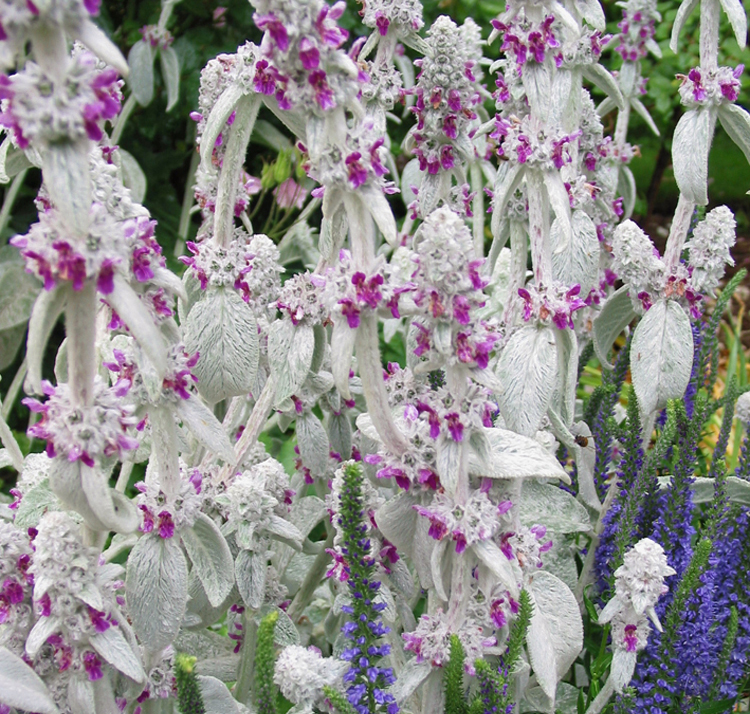
Woolly foliage stems & flowers soft enough for patting
The whole plant is covered with soft, grey-white, woolly fur, which makes it hard to resist running your hands over to savour the texture.
Showy deep rose-purple flower spires encased in grey wool
Although Stachys byzantina is most commonly used as a feature edge or groundcover because of its glowing pale colour and wonderful foliage texture, it is actually a showy bloomer as well.
Blooming summer flower spires
Woolly Lamb’s Ears put up a thicket of flower spires during summer, with the rose-purple flower trumpets clasped amongst the white wool.
Flower spires reach approx. 45cm. high at the peak of summer flowering.
Then when flowering is finished – it is simple to shear all the stems back to ground level, and the Lamb’s Ears go back to their routine life as a fabulous groundcover or edging plant.
Useful groundcover & companion plant
Stachys byzantina is a thoroughly useful groundcover under roses, shrubs and fruiting trees.
With a traditional reputation as a companion plant for helping to repel harmful insects from roses, veggies and fruit.
Perfect edging plant
Though wherever placed it also makes a very pretty and hardy edging plant.
With brilliant grey-white foliage colour and textural interest all year round.
But the quality I like best is that it resists the scratching of pesky Blackbirds that do their best to move my mulch from the garden to the lawn.
Stachys byzantina grows naturally dense, matting groundcover., defying the Blackbirds.
Super tough & easy grower
Plant Woolly Lamb’s Ears in either Full Sun or Partial Shade, and it will even grow in dense Shade if necessary.
Though flowering will be more prolific with more sun.
Water-wise & heat hardy
Stachys macrantha is a tough and easy grower that can cope well with periods of heat and dry, as well as some stints of humidity if necessary.
All that lovely white wool is perfectly designed as insulation for the plant against heat, strong sun rays, wind and dehydration.
Humidity resistant
Woolly Lamb’s Ears can also resist some summer humidity.
Though in districts with higher summer humidity it is important to make sure they have full sun, plenty of air movement, good drainage and no overhead watering.
Vigorously frost hardy
Super-hardy Stachys is also vigorously frost hardy and resists temperatures down to at least -20C, depending on conditions.
Not fussy about soil type
Plus it is unfussy about soil type, as long as the position is well drained.
It is equally happy in sandy, rocky, gravel or loam soils.
With a soil pH from mildly acidic to more alkaline.
So in acid soils they will certainly appreciate some lime whenever you do the roses.
However Stachys byzantina cannot tolerate being water-logged at all, ever never.
Deer & rabbit resistant
Fortunately rabbits and deer find Stachys foliage unattractive to eat.
The bees knees for nectar
While bees and helpful pollinating insects find the mass of trumpet flowers just the “bees-knees” for nectar. And will buzz amongst them all day doing their job.
Hardy perennial groundcover or edge
Stachys byzantina is a super tough, evergreen (or rather ever-grey) perennial groundcover carpet. Shoots to 45-60cm. High with massed flower spikes in summer x 45cm. Wide dense, low, matting foliage clump.
Mass plant for dense, soil securing groundcover.
Ideal on banks & slopes that need securing
Woolly Lamb’s Ears is ideal massed planted on banks and slopes that need retaining.
SEED SOWING ADVICE: QUICK & EASY
Seed can be simply scattered outdoors in winter or early spring
OR
For optimum germination sow indoors at any time when suitable temperatures can be provided (18-22°C).
Sow indoors for best germination plus quick & earlier plants: First scatter the seed on the surface of good quality potting mix.
Then pat the seeds gently to the surface of the mix to ensure good contact.
These seeds need light for germination, so do not cover with mix.
Then thoroughly moisten the mix by standing the punnet in a shallow water bath.
And allow the moisture to percolate up to the surface from below.
Now cover the punnet with a clear plastic lid or plastic bag to help maintain consistent moisture.
And place the covered punnet in a warm position (not in any direct sunlight) for 2-4 weeks.
You can use a heat mat if you have one, and this helps maintain optimum temperatures.
Temperatures of 18-22°C are best for optimum germination.
Continue to keep consistently moist by misting the surface from a spray water bottle.
Seeds usually begin to sprout in approx. 14-30 days.
Though some seeds may emerge later. This is a natural strategy for this plant to hedge bets for the seedlings. So do not discard the punnet.
Remove the clear cover as soon as germination begins.
And prick out the seedlings quickly, as soon as they develop their first set of true leaves.
To grow them on in small pots until you are ready to plant out in the garden.
Seed Count: 60 seeds per pack approx.
(We always aim to exceed the stated seed count and give a generous serve).
Click here for Nursery Open Days & Open Gardens Information
https://www.gardivalia.com.au/open-gardens
Click here to go back to Seeds Shop
https://www.seedscape.net.au/shop/
Related products
-
 Add to WishlistAlready In WishlistAdd to Wishlist
 -
 Add to WishlistAlready In WishlistAdd to Wishlist
 -
 Add to WishlistAlready In WishlistAdd to Wishlist
 -
 Add to WishlistAlready In WishlistAdd to Wishlist