
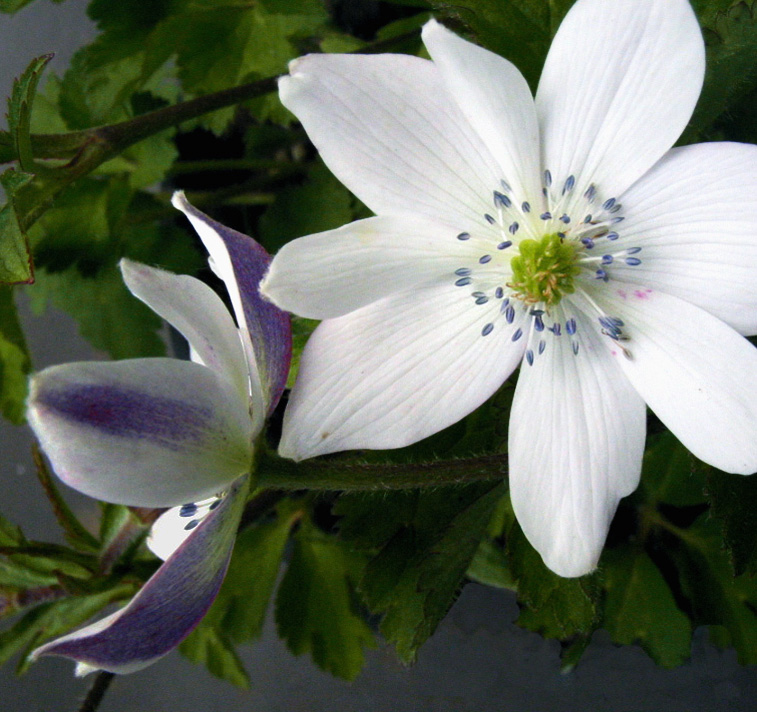
Anemone leveillei
CROWN ANEMONE
$5.00 AUD
Availability: In stock
- 1-9 pkts $5.00
- 10 pkts FREE
- Express post $12
Anemone leveillei
CROWN ANEMONE
Anemone leveillei is a delightful and dainty Windflower.
Snow white stars with purple blue crown & mauve flushed backs
Snow white stars are crowned with a centre of prominent purple-blue anthers.
While the backs of the flowers are flushed with mauve.
Sparkling contrast between crisp white stars & deep dark anthers
The vivid contrast between the pristine white star petals and the deep, dark purple-blue anthers,
Lights up every flower – so the clump seems to sparkle.
Flocks of mauve flushed backs – flash in every breeze
The flowers of Anemone leveillei are borne proudly above the foliage in large flocks.
On upright, much branched stems.
So the flocks of flowers twist and turn in even the slightest breeze – flashing their mauve backs amongst the white stars.
Pretty & neat perennial foliage mound
Anemone leveillei is also a lovely foliage plant.
With deeply divided, softly hairy leaves, that form a neat foliage mound.
One of the best groundcovers for shade & under trees & shrubs
Anemone leveillei is a natural born woodlander (from China).
So it adores the Dappled Light & Shade under trees and shrubs, or shaded gardens.
Where it gently clumps to form a dense groundcover, that can effectively suppress weeds.
It is not invasive, but can be mass planted to form a dense carpet.
Bright star blooms over spring-summer
The clumps sparkle and flash with flowers for a long blooming period over late spring and early summer.
Each clump forms a low mound approx. 45-60cm wide and very dense with foliage; and approx. 20-45cm. high.
Long-lived perennial
Anemone leveillei is a particularly long-lived and robust growing perennial, so it will be a highlight in your shaded areas for many years.
Bumper frost hardy
Frost hardy Anemone leveillei can withstand frost temperatures down to a stonking -30°C.
Also tolerates summer humidity
Plus tolerate summer humidity.
Easy to grow and low maintenance perennial clump or groundcover
It is easy to grow in suitable conditions and does not need pruning or regular maintenance.
And is rarely if ever troubled by any pests or diseases.
Clumps or groundcovers of Anemone leveillei enjoy an annual summer mulch of organic matter – cane mulch / leaves / compost / manure / straw – any or all of the above.
Rabbit & deer resistant
Windflowers are not to the taste of rabbits and deer, as they have an acrid, bitter taste.
While bees can’t resist those pollen laden anthers
Honeybees, as well as many native bees, simply cant resist those pollen laden, purple-blue anthers (many bees are attracted to the colours purple and blue).
Grows well in wide range of soils can also tolerate clay & bog
Anemone leveillei thrives in normal garden loam conditions, but can also do well in a wide range of soils, from sandy to clay.
Plus tolerate soils of a wide range of pH – from acid to neutral to alkaline, lime soils.
But if necessary – it can also grow in heavy clay soils.
SEED SOWING ADVICE:
Sow Anemone leveillei seeds at any time indoors in a punnet, whenever suitable temperatures can be provided (around 15°C)
OR
Scatter directly in garden in autumn and winter to allow for winter chilling.
Sowing indoors for maximum germination & early plants: First sow Anemone leveillei seeds in a punnet, on the surface of good quality seed raising mix.
Then gently press the seeds to the surface of the mix to ensure good contact, but barely cover with sieved mix.
Now stand the sown punnet in a shallow water bath and allow the moisture to soak through from below until the surface is moist.
Then drain and place in a well-lit position, but NOT in any direct sunlight.
Continue to keep the punnet and surface of the mix consistently moist.
Because these seeds should never be allowed to dry out – this will hinder germination.
So mist regularly from a spray water bottle, and re-soak if necessary.
Covering the punnet with a clear plastic lid will also help to maintain consistent moisture and prevent drying out.
Anemone leveillei seeds need cool temperatures of around 15°C. for germination, and temperatures above 20°C can inhibit germination and cause the seed to go back into dormancy.
These seeds benefit from a period of moist chilling to break their natural dormancy.
So if there is no germination in 3-4 weeks – the seeds have entered dormancy.
So wrap the moist punnet in cling-wrap or a plastic bag.
And keep in fridge (not freezer) for 4-6 weeks minimum, or even longer if you can.
Then remove, unwrap, and return to a cool, well lit, (but no direct sunlight) position.
At temperatures around 15°C, and not above 20°C, for germination.
Seedlings will begin emerging in approx. 30 days. Do not discard punnet quickly, as these seeds will naturally continue to germinate over a long period of time – this a natural trick of this plant to give baby seedlings a sporting chance.
Seed Count: 10 seeds per pack approx.
(We always aim to exceed the stated seed count, and give a generous serve).
Click here for Nursery Open Days & Open Gardens Information
https://www.gardivalia.com.au/open-gardens
Click here to go back to Seeds Shop
https://www.seedscape.net.au/shop/
Related products
-
 Add to WishlistAlready In WishlistAdd to Wishlist
 -
 Add to WishlistAlready In WishlistAdd to Wishlist
 -
 Add to WishlistAlready In WishlistAdd to Wishlist
 -
 Add to WishlistAlready In WishlistAdd to Wishlist