
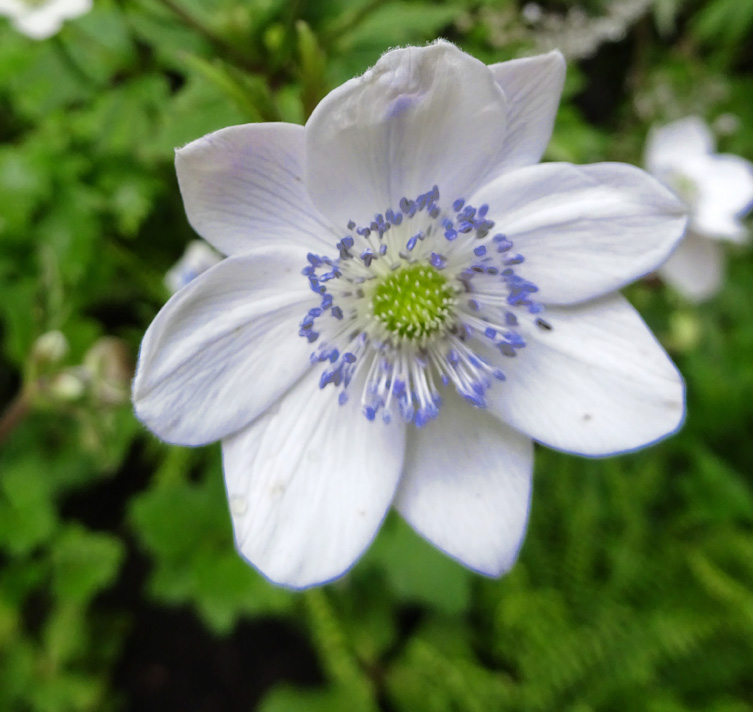
Anemone rivularis
BLUE BACKED WINDFLOWER
$5.50 AUD
Availability: In stock
- 1-9 pkts $5.00
- 10 pkts FREE
- Express post $12
Anemone rivularis
BLUE BACKED WINDFLOWER
Anemone rivularis is one of the most beautiful of all the Windflowers in my humble opinion.
Snow white saucers with indigo stamens & blue flushed backs
This loveliest of Windflower has large, snow white saucers with showy indigo-blue stamens, and blue flushed backs.
Exquisite blooms in spring-summer
More commonly known Windflowers are autumn bloomers, but this refined beauty blooms through late spring and early summer.
Decorative branching stems hold flocks of flowers
The flowers are borne on branching 60cm stems flushed with red – so they also make a colour contrast in the garden.
As they proudly hold flocks of flowers and buds well above the foliage.
Neat ferny foliage mound
While the pretty, deeply divided leaves form a neat, dense mound approx. 60cm in diameter.
Treasure for under trees & shrubs
Anemone rivularis is a treasure for Dappled Shade or Shade under trees and shrubs.
Mass plant for lovely shade groundcover
And it looks marvellous mass planted as a shade groundcover carpet, as both the flowers and foliage are so strikingly pretty.
Bumper frost hardy
Frost hardy Anemone rivularis can withstand frost temperatures down to at least -20°C.
Also tolerates summer humidity
Plus tolerate summer humidity and heat.
As it has a wide native range, with hugely different climate extremes – from China, through India, and right down to Indonesia and Sri Lanka.
Easy to grow and low maintenance perennial clump
It is easy to grow in suitable conditions and does not need pruning or regular maintenance.
And is rarely if ever troubled by any pests or diseases.
Rabbit & deer resistant
Windflowers are not to the taste of rabbits and deer, as they have an acrid, bitter taste.
While bees can’t resist those blue anthers
Honeybees, as well as many native bees, simply cant resist those pollen laden, blue anthers (many bees are attracted to the colour blue).
Grows well in garden loam but can also tolerate clay & bog
Anemone rivularis thrives in normal garden loam conditions.
Plus tolerate soils of a wide range of pH – from acid to neutral to alkaline, lime soils.
But if necessary – it can also grow in heavy clay soils that may even become waterlogged or boggy at times.
SEED SOWING ADVICE:
Sow seeds of Anemone rivularis at any time indoors in punnets, when suitable temperatures can be provided (18-20°C – but not above 20°C)
OR
Scatter directly in garden in autumn and winter – so the seed is conditioned by the cold of winter.
Indoors for quick plants: First sow the seeds on the surface of good quality seed raising mix.
Now press the seeds gently into the surface of the mix.
And then barely cover with mix.
Now thoroughly moisten the punnet by standing in a shallow water-bath and allowing the moisture to percolate up to the surface of the mix from below.
Then place the punnet in a cool, well-lit position (not in any direct sunlight).
Because temperatures above 20°C may slow down germination.
Temperatures of 18-20°C are optimum.
Continue to keep the punnet consistently moist by misting with a spray water-bottle.
But if the seeds are shy to germinate, and none have emerged in 3-4 weeks – they have entered natural dormancy and require chilling (a “pretend winter”) to condition them for germination.
So wrap the moist, sown punnet in cling-wrap / a plastic bag.
Then keep the punnet in the fridge (not freezer) for 2-4 weeks. This will mimic winter and break the natural dormancy of the seed.
Now return it again to a cool position where the temperatures are preferably under 20°C, for germination.
Seedlings begin emerging in approx. 30 days.
But do not discard the punnet too quickly, as seeds will continue to germinate. Because this is a natural and cunning trick by this plant – it staggers the seed germination rate, to give some seeds a better chance to emerge into favourable conditions in a harsh and variable climate.
Seed Count: 10 seeds per pack approx.
(We always aim to exceed the stated seed count, and give a generous serve).
Click here for Nursery Open Days & Open Gardens Information
https://www.gardivalia.com.au/open-gardens
Click here to go back to Seeds Shop
https://www.seedscape.net.au/shop/
Related products
-
 Add to WishlistAlready In WishlistAdd to Wishlist
 -
 Add to WishlistAlready In WishlistAdd to Wishlist
 -
 Add to WishlistAlready In WishlistAdd to Wishlist
 -
 All
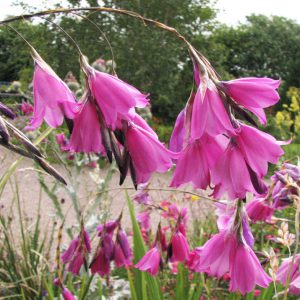
AllDierama pulcherrimum
‘Rose Pink’
ROSE PINK
FAIRY FISHING RODS
SALE: Buy 1 get 2 packs
$5.50 AUD Add to cartAdd to WishlistAlready In WishlistAdd to Wishlist