
Angelica gigas
KOREAN ANGELICA
$5.00 AUD
Availability: In stock
- 1-9 pkts $5.00
- 10 pkts FREE
- Express post $12
Angelica gigas
KOREAN ANGELICA
Angelica gigas is a big eye-catcher in the garden, and no trouble to have.
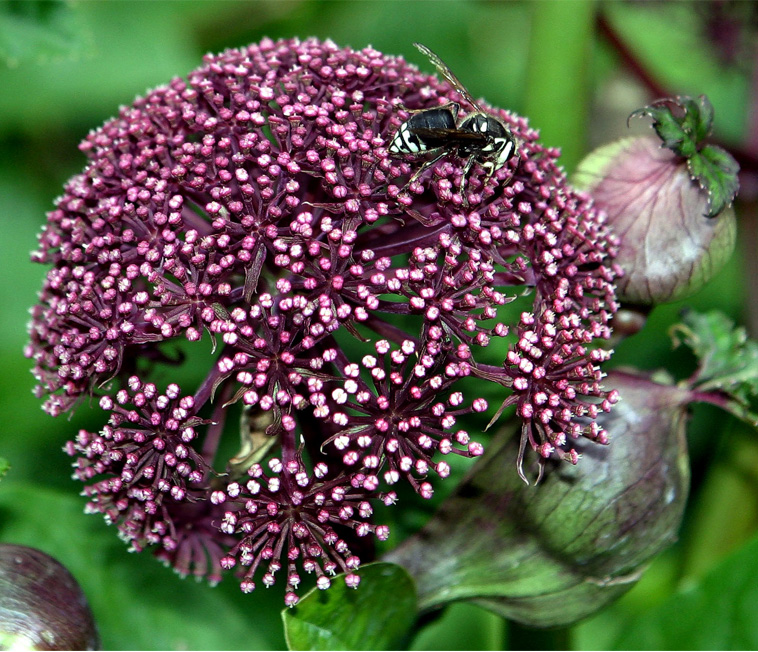
Huge domes of claret-purple flowers
Huge domes of rich, deep claret-purple are packed with tiny flowers.
With flower heads approx. 15 to 20cm. across.
Held aloft on deep purple strong stems
And they are held boldly aloft on very striking deep purple stems that branch into strong shapes.
Striking architectural plant adding dark drama
The whole plant of Angelica gigas is dramatic – from the big domes of claret flowers, held on branching dark purple stems, to the striking large fingered leaves that look as if the have been polished.
It creates very strong, architectural shapes that contrast so nicely with softer plants.
Tall upright beauty – ideal for the back or with shrubs
Angelica gigas is tall and upright – more up than out – a splendid statement.
So it is ideal for planting at the back of the flower bed, as a foil for softer, finer, or dainty plants in front.
And looks very strong amongst billowing shrubs.
More up than out
It towers approx. 1.5 to 1.8 metres tall, and even to 2m. if more moisture is available.
But only approx. 60 to 80cm wide.
Splendid flower display over summer & into autumn
Angelica gigas cuts a splendid figure even when it is not in flower, with the very decorative glossy foliage and dark stems.
But when those giant heads start to sell up as summer comes – look out – it catched every eye through summer and into autumn.
Super-duper cut flower for floristry
Wow – you only need to cut one branching stem of flower heads and you have a vase.
Aromatic flowers
The flowers also have an attractive, aromatic scent.
Loves living a shady life
Angelica gigas is a native of woodland and grassy areas in Korea – so it really appreciates some dappled shade – perfect amongst trees and shrubs, or a flower border that receives some shade in the hottest part of the afternoon.
However it can tolerate full sun in cooler or southern climates.
Frost hardy + tolerates humidity
Bless this Korean Angelica – it is frost hardy down to approx. -20°C, and also tolerates summer humidity if needed – that is one obliging plant.
Easy to grow in a wide range of soils – from sandy to clay
Angelica gigas grows happily in an extremely wide range of soils – from sandy to heavy clay.
However it does appreciate some lime in acid soils.
It has a deep, strong tap root – so is able to forage well, and resist being blown over.
But it will require a little extra and more regular water in sandy soils.
Can tolerate heavy clay soils or boggy spots too
Because of its native habitat, which includes Korean stream sides, Angelica gigas can also tolerate boggy spots if needed.
Rich in pollen & nectar for our pollinators
Our valuable bees (both native and honeybees), night flying moths, butterflies, and even small honey-eating native birds – all enjoy the rich pollen and nectar supplies from these giant flower heads.
Loved by native birds
And if you don’t deadhead and leave the flower domes to go naturally to seed – then the native seed-eating birds just love the feast.
Traditional herbal medicine of the east
The roots of Angelica gigas have been widely used in both Korean and Chinese herbal medicines, over many centuries.
Traditional uses have included treatment for blood disorders, inflammation, menstrual problems, memory enhancement, and cell disorders.
Modern research is ongoing.
Self seeds to give the next generation of stately beauties
Angelica gigas is both a perennial and a self sowing biennial.
So if you cut the flowers, or dead-head each year before they go to seed – then the plant remains as a perennial for future years.
But don’t worry if you forget – the seeds will drop around the parent and self slow some new babies for future years.
Seedlings grow to full architectural beauty in the first year, then flower in their second year.
SEED SOWING ADVICE: Angelica gigas
Seeds of Angelica gigas can be sown in either autumn or spring, or whenever suitable temperatures can be provided (approx. 18°C).
Seeds can be scattered directly in the garden in autumn (so they get the required period of chilling in winter) and lightly covered. They then germinate in spring.
OR
Sown indoors in small pots, whenever suitable temperatures can be provided for more controlled germination.
Small individual pots or tubes are preferred for sowing Angelica gigas, as the seedlings quickly develop their strong, long tap root.
First sow the seeds in quality seed raising mix, then just cover with sieved mix or fine vermiculite.
As these seeds need light to germinate.
Now thoroughly moisten the little pots by standing them in a shallow water bath and allowing the moisture to percolate up to the surface from below.
Then wrap in cling-wrap or a plastic bag.
And place in the fridge (not in the freezer). for 30 days to mimic winter chilling.
After 30 days remove from the fridge and place in a well-lit place (not in any direct sun).
Temperatures of approx. 18°C. are best for rapid and optimum germination once the seeds have received their period of chilling.
Continue to keep consistently moist by misting with a spray water bottle.
Seeds usually begin to germinate in approx. 30 days. But patience is also needed, as it is normal for not all seeds come at once (this is a natural defence of the plant to give the babies a sporting chance).
Patience – Do not discard.
If some seeds are shy to germinate – you can also give them a second period of chilling.
Once the seedlings have their first set of true leaves, they can be placed out into the garden as soon as the roots reach they bottom of the tube.
Seed Count: 10 seeds per pack approx.
(We always aim to exceed the stated seed count and give a generous serve).
Click here for Nursery Open Days & Open Gardens Information
https://www.gardivalia.com.au/open-gardens
Click here to go back to Seeds Shop
https://www.seedscape.net.au/shop/
Related products
-
 Add to WishlistAlready In WishlistAdd to Wishlist
 -
 Add to WishlistAlready In WishlistAdd to Wishlist
 -
 Add to WishlistAlready In WishlistAdd to Wishlist
 -
 Add to WishlistAlready In WishlistAdd to Wishlist