Asclepias physocarpa
HAIRY BALLS
SWAN PLANT
Asclepias physocarpa has the rather bawdy common name of “Hairy Balls”.
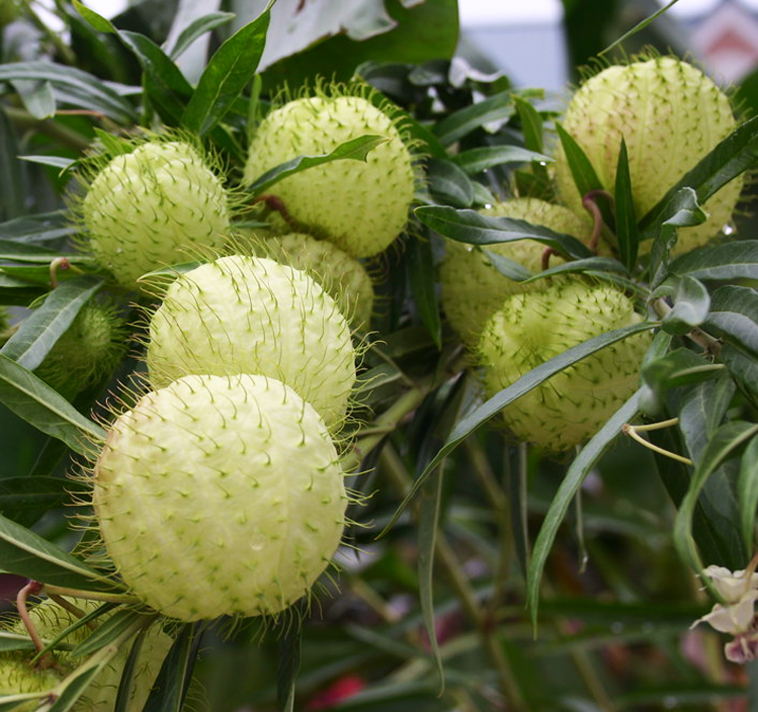
Large green balloons like “Hairy Balls”
“Hairy Balls” because of the large, inflated, hairy, green seed pods.
So gardeners of a delicate disposition – be warned – please use one of the other many other common names for this beloved and popular plant.
Some other bawdy common names
Because Asclepias physocarpa is also known as “The Family Jewels Bush” (oh dear – still indelicate and suggestive) or “Swan Plant”, or “Balloon Plant” or “Bishop’s Balls” (oh dear – it is getting worse).
Prized by florists
But the stems of seed pods are always prized by florists, no matter what common name you choose.
Long lasting in a vase
The cut stems of “Hairy Balls” are long-lasting in the vase, and are always sure to draw attention to any arrangement.
Or float a lake of fat little swans – from “Swan Plant”
But the seed pods also look like fat little swans, so they can be floated in a bowl of water to make a mini swan lake.
So the alternative common name of “Swan Plant” is also very popular.
Attractive flowers & vanilla scent
The hairy green pods come after attractive pink & cream flowers, which are also sweetly scented of vanilla.
So Asclepias physocarpa is not just all about the seed pods.
Long summer & autumn blooming & balling
And the long summer blooming is extended into the autumn with the unmissable, eye-smacking, seed pods on upright perennial stems.
A good old fashioned hardy standby
In days gone by, no self-respecting cottage or farm garden would be seen dead without a “Swan Plant” or “Hairy Balls”.
Tough growers in difficult spots
Because they are resilient and hardy growers, in the face of all sorts of difficult conditions.
So they are best planted in Full Sun.
Water-wise & drought resistant
Where they are water-wise perennials, and noted for heat & drought resistance.
Asclepias physocarpus will self seed in the garden in ideal conditions.
And it is not suitable for sending to QLD.
1.2m High shrubby perennial x 90cm Wide.
SOWING ADVICE: QUICK & EASY
Sow any time indoors in a punnet, whenever suitable temperatures can be provided (15-25°C).
OR
Sow directly in the garden in autumn.
Sow indoors for optimum germination: First sow the seeds on the surface of good quality seed raising mix in a punnet.
Then press the seeds gently into surface to ensure good contact and cover with 3mm. of sieved mix.
Now thoroughly moisten the punnet by standing it in a shallow water bath.
And allow the moisture to percolate up to the top of the mix from below.
Place in a warm, well-lit position (not in any direct sunlight – as this will dry the seeds out & stop germination).
Temperatures of 15-25°C are ideal for rapid and optimum germination.
Continue to keep the punnet consistently moist by regularly misting with a spray water-bottle.
Covering the punnet with a clear plastic lid or plastic bag will also help to retain consistent moisture between mistings.
Remove cover as soon as sprouting commences.
Seedlings may begin emerging as soon as 10 days, but normally take 14-28 days approx.
Seed Count: 10 seeds per pack approx.
(We always aim to exceed the stated seed count, and give a generous serve).