Iris chrysographes
THE BLACK IRIS
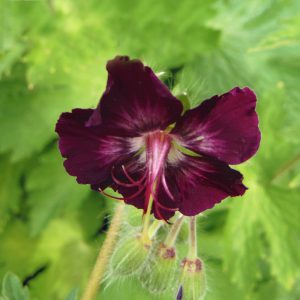
Iris chrysographes bears sprays of the darkest, almost wicked black, velvety flowers.
Darkest, wicked black, velvety flowers
With each bloom also delicately marked with golden lines, looking as if they have been drawn on with a fine golden pencil.
Deliciously fragrant
Blooms are also deliciously fragrant and produced in summer on tall, strong stems.
Neat grey-green clumps of sword shaped foliage
With blooms held well above clumps of neat, grey-green, sword like foliage.
So making an elegant combination.
Prized by discerning gardeners
Thus little wonder – Iris chrysographes is one of the most highly prized of all Iris amongst discerning gardeners.
And it is not hard to grow.
Grows in full sun to part shade
Iris chrysographes enjoys humus rich, moist but well drained soil.
And will then happily grow in Full Sun to Light Shade.
Copes well with summer humidity
Beautiful Iris chrysographes is a native of China and Myanmar.
Where it grows in grassy meadows, stream sides, hillsides and forest margins.
So it is well able to cope with summer humidity.
Also frost hardy
Delightful Iris chrysographes can also handle moderate frosts, and should be hardy in temperatures down to around -5°C.
If your frosts are even more severe, then plant it where it receives some overhead protection from neighbouring shrubs etc – it grows happily in part shade, and is native to forest margins.
Attracts useful pollinators
Our friends the bees (both native bees and honey-bees) and butterflies – just adore the blooms of Iris chrysographes.
As they are rich in both pollen and nectar.
Rabbit & deer resistant
However our foes, the rabbits and deer, do not graze Iris chrysographes. May they starve.
70cm. High in elegant flower x 25cm. Wide clump of handsome, fanning foliage.
SEED SOWING ADVICE: Iris chrysographes
Seed can be sown at any time into a good quality seed raising mix.
Whenever suitable temperatures can be provided.
First gently rub the seeds between 2 pieces of fine sandpaper, or some sand, to roughen the hard seed coating. This will allow moisture to penetrate the seed to initiate germination.
Then soak the seeds in water that is hot to the touch (not boiling – you should be able to put you finger in without burning).
Leave the seeds in the water for 24 hours, then repeat with fresh hot water for a further 24 hours.
Any seeds that float to the surface have not absorbed water and need to have their surface further roughened and then re-soaked.
While seeds that sink to the bottom are absorbing water and are ready to sow now.
Now place the seeds in their pot / punnet and cover the seed with sieved quality seed raising mix / or fine river sand – to approximately their own depth.
Then place the sown, moist punnet in a warm, well lit position (not with any direct sunlight) for a pre-conditioning period of 4 weeks.
Best temperatures for pre-conditioning are 15-20°C
Then wrap the punnet in cling-wrap or a plastic bag and place in the fridge (not freezer) for 9 weeks.
Now remove from the fridge, unwrap, moisten punnet and place in a warm, well-lit position (not in direct sunlight).
Temperatures of 15-20°C now. are ideal for rapid and optimum germination.
Seed Count: 5 seeds per pack (seed of this beautiful but rare Iris is scarce).
Click here for Nursery Open Days & Open Gardens Information
https://www.gardivalia.com.au/open-gardens
Click here to go back to Seeds Shop
https://www.seedscape.net.au/shop/