
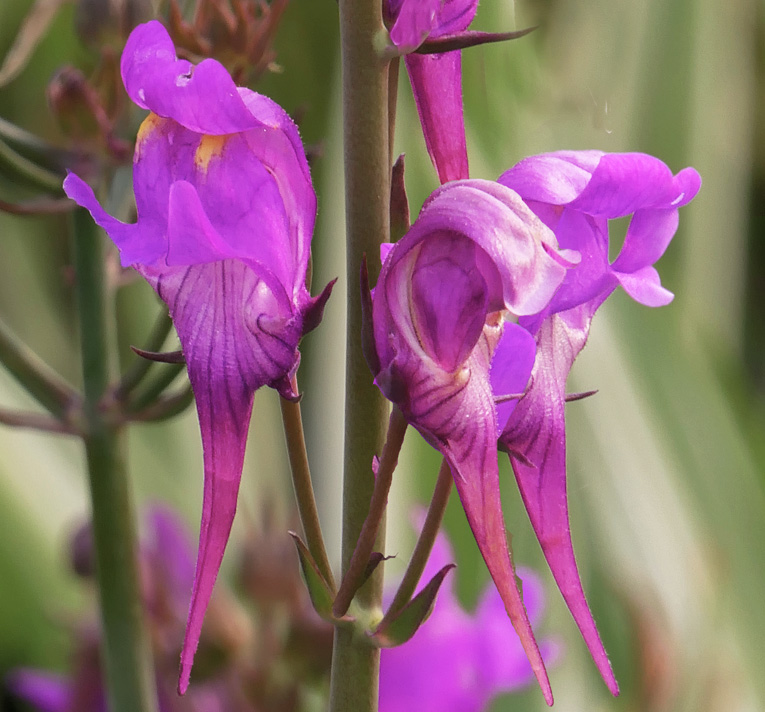
Linaria triornithophora
‘Three Birds Flying’
3 BUDGIES
SALE: Buy 1 get 2 packs
$5.00
Availability: In stock
- 1-9 pkts $5.00
- 10 pkts FREE
- Express post $12
Linaria triornithophora ‘Three Birds Flying’
3 BUDGIES
SALE: Buy 1 get 2 packs
Linaria triornithophora ‘Three Birds Flying’ is an exceptionally good plant, but is little known and rarely seen in Australian gardens. Shame – it is such fun.
The Budgie plant
It blooms with large, yellow lipped, long tailed, purple “Snapdragon” style flowers.
And the blooms are held on stout stems in groups of three – so they look for all the world like three little Budgerigars perched and having a chat.
Perfect for water-wise Australian gardens
Linaria triornithophora ‘Three Birds Flying’ is a native of Spain and Portugal.
Where it is perfectly adapted to long, hot, dry summers plus cold winters.
So it is ideal for water-wise Australian gardens with similar climates.
Fun plant for gardening with kids
Kids just love the “Budgie” flowers.
And it is a showy plant, certainly no shrinking violet in the garden.
Plus bone easy and quick to grow.
So perfect for kids (and beginners) to begin having a go in the garden – with lots of satisfaction guaranteed.
Long blooming with Budgies over spring summer & autumn
Linaria triornithophora ‘Three Birds Flying’ continues to produce a succession of upright stems, each topped with the three Budgies of course.
With flower spires coming all through spring, summer and autumn.
Upright & slender for pots or small spaces
It is an upstanding, slender plant – so also ideal for pots or small spaces, even though it is quite tall and showy.
And the sage-blue-green, thin foliage sets off the colour of the flowers so well.
Fascinating watching the honeybees open the “Budgies”
Honeybees are fascinating to watch as they work the flowers, which are rich in both pollen and nectar.
The bee has to walk down the long tail of the flower, to use its weight to open the flower mouth, then pop inside.
The wonder is – how do they know – but they do. Fascinating !!!
Easily pleased in sun or part shade
‘Three Birds Flying’ is a very easy plant to please.
So plant it in full sun or part shade.
Nor is it fussy about soil type, as long as it is well drained, as it does not enjoy a bog.
It is moderately frost hardy. Though in areas with very heavy frosty winters, then it is best planted where it has some overhead cover – near some trees are taller shrubs, beside a wall etc.
Water-wise & drought resistant
It is also naturally adapted to heat and dry, as a native of Spain and Portugal.
And it is not a water-thirsty plant, providing it is given some mulch during hot summers.
Then it has good drought resistance once established.
Hardy & easy perennial
90cm. High in spires of bloom over all the warm months x 25cm. Wide mound of grey-green leaves in winter.
Low maintenance
The only work to do if you wish to tidy up in winter, is to cut back the flower stems to the leafy base after the long months of blooming. Then all is clear for the new flower stems next spring.
SEED SOWING ADVICE: QUICK & EASY
Seeds of Linaria triornithophora can be sown directly in the garden in spring, as soon as the frosts have gone & the soil has warmed.
OR
Sown indoors in a punnet whenever suitable temperatures are available (18-25°C).
You can use a heat mat to maintain temperature.
Sow indoors for optimum germination, quick & early plants: First sow the seeds on the surface of good quality seed raising mix in a punnet or small pot.
Now barely cover the seeds with sieved mix / fine vermiculate / fine grit.
Because these seeds need light to germinate.
Then thoroughly moisten the punnet by standing it in a shallow water-bath, and allowing the moisture to percolate up to the surface of the mix from below.
Then place the sown, moist punnet in a warm, well-lit position (but not in any direct sunlight).
Temperatures of 18-25°C approx. are best for rapid and optimum germination.
So you can use a temperature controlled heat mat to maintain consistent warmth.
Or place the punnet in a warm position (no direct sun).
Continue to keep moist by misting from a spray water-bottle.
Covering the punnet with a clear lid or plastic bag will also help to maintain consistent moisture.
Seedlings emerge in approx. 7-21 days.
Seed Count: 70 seeds per pack approx.
(We always aim to exceed the stated seed count, and give a generous serve).
Click here for Nursery Open Days & Open Gardens Information
https://www.gardivalia.com.au/open-gardens
Click here to go back to Seeds Shop
https://www.seedscape.net.au/shop/
Related products
-
 Add to WishlistAlready In WishlistAdd to Wishlist
 -
 Add to WishlistAlready In WishlistAdd to Wishlist
 -
 Add to WishlistAlready In WishlistAdd to Wishlist
 -
 Add to WishlistAlready In WishlistAdd to Wishlist