
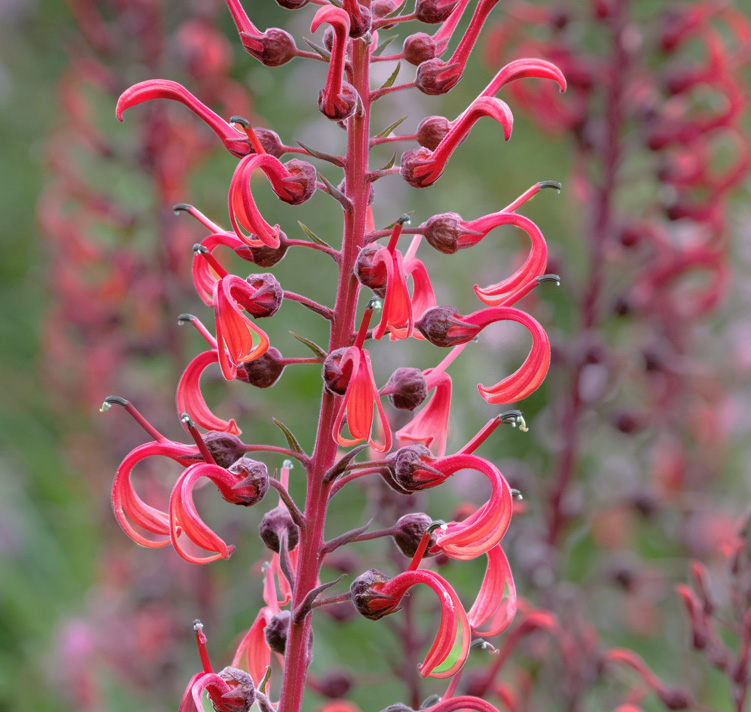
Lobelia tupa
DEVIL’S TOBACCO
$5.00
Availability: In stock
- 1-9 pkts $5.00
- 10 pkts FREE
- Express post $12
Lobelia tupa
Devil’s Tobacco
Lobelia tupa can only be described as spectacular.
Spectacular giant Lobelia flowers in autumn
Because this wonderful plant from Chile knocks your socks off in autumn.
Deep rich intense red spidery paws
When it blooms with giant Lobelia flowers of deep, rich, intense, velvety red.
Looking like giant, spidery Kangaroo Paws.
Towers of flowers
Flower stems tower up to at least 1.5m. and can even make 2.4m !!!
While the blooms are borne along the stems in long, airy, spidery spires.
And successively open up the stems over a long period. Wow!!!
Above large felty foliage rosette
The foliage of Lobelia tupa is also handsome and decorative.
With felty, grey-green, large lance-shaped leaves forming a mounding rosette.
Upright flower spires for autumn
From which the flower stems rise over summer, to crown the autumn with glorious flowers.
It is an upright growing plant.
Plant in full sun to part shade
Lobelia tupa is an easy growing plant and thrives in either full sun or partly shaded positions.
Thrives in wide range of soils
It is not fussy about soil type, as long as it is well drained (they cannot abide a bog).
And they love to have some mulch or organic humus to maintain stable moisture levels.
But the soil does not have to be rich, and Lobelia tupa is best grown with little to no fertilizing.
Nectar rich blooms for bees & native birds
The giant tubular flowers of Lobelia tupa are perfectly designed for our native honeyeater birds, native and honeybees, butterflies and loads of other useful insect pollinators.
The flower tubes are simply packed with nectar.
And with their long autumn blooming season – the nectar is such a boon to all our flying friends as they bulk up ready for the hardships of winter.
Rabbits & deer wont touch
However the caustic sap in the plant burns the mouth if chewed (hence the common name of “Devil’s Tobacco”).
So it quite puts chewing beasts off.
Traditional South American medicinal
Lobelia tupa should not be eaten – fortunately the caustic sap stops any desire to eat it- as the plant is toxic if ingested in large quantities.
But do wear gloves when cutting in case the sap causes skin irritation.
The Mapucho peoples of Chile did use the plant for medicinal purposes, including pain relief, but it is not recommended by modern science.
Resists moderate frost
This beautiful plant is moderately frost resistant, being able to survive down to -10°C.
Or plant near taller trees
And it does even better in severely frosty areas if it is given some overhead shelter – such as the shelter from taller trees.
Happily it does grow in part shade or dappled sun so all is possible.
Lobelia tupa is a native of deciduous and evergreen forests in Chile.
Spectacular perennial for the back
A spectacular perennial for the back of the border.
Growing from 1.5 to 2.4 metres High in autumn flower spires x 1m. Wide clump of felty foliage.
Lobelia tupa will stay as an evergreen perennial in mild winter areas, and become a deciduous perennial in cold, frosty winter areas.
Seed Sowing Advice: Quick & Easy
Seeds of Lobelia tupa can be sown indoors at any time when suitable temperatures can be provided (18-24°C).
OR
Sown directly into the garden in spring.
Sow indoors for optimum germination, quick & early plants: First sow the seeds in a punnet on the surface of good quality seed raising mix.
Tip for easy sowing of Lobelia tupa seeds: Lobelia seed are very fine – making them difficult to spread effectively. So first sieve some seed raising mix to make it fine. Then put the fine sievings into the bag containing the seed – this gathers up the fine seed and makes it easy to spread properly. Shake like mad, and then sow all the contents of the bag.
Now just gently pat the surface of the sown mix to ensure good contact of the seeds with the surface.
But do not cover.
As these seeds need light to germinate.
Then thoroughly moisten the sown punnet by standing it in a shallow water bath, and allow the moisture to percolate up to the surface of the mix from below.
Seeds enjoy a warm spot
Now place the moist sown punnet in a warm, well-lit position (not in any direct sunlight).
Temperatures of 18-24°C are ideal for rapid and optimum germination.
You can use a heat mat to maintain temperature if you wish.
Continue to keep consistently moist by misting from a spray water-bottle.
Covering the punnet with a clear plastic lid or plastic bag will also help to retain moisture and prevent drying out.
Seeds begin to germinate in approx. 14-21 days.
However if they are shy to germinate – then they need a period of chilling to break their natural dormancy.
So wrap the moist, sown punnet in cling-wrap or a plastic bag.
And place in the fridge for 4-6 weeks.
This will mimic the action of winter to break natural dormancy.
Then return the punnet to the warm, well-lit position for germination.
Prick out the seedlings as soon as they have developed their first set of true leaves.
And pot to grow on until they are ready to plant out into the garden.
Seed Count: 6 seeds per pack.
(We always aim to exceed the stated seed count and give a generous serve).
Click here for Nursery Open Days & Open Gardens Information
https://www.gardivalia.com.au/open-gardens
Click here to go back to Seeds Shop
https://www.seedscape.net.au/shop
Related products
-
 Add to WishlistAlready In WishlistAdd to Wishlist
 -
 Add to WishlistAlready In WishlistAdd to Wishlist
 -
 Add to WishlistAlready In WishlistAdd to Wishlist
 -
 All
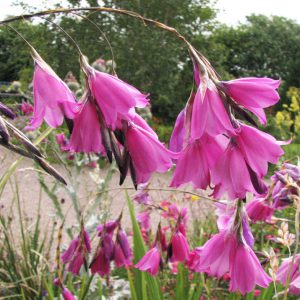
AllDierama pulcherrimum
‘Rose Pink’
ROSE PINK
FAIRY FISHING RODS
SALE: Buy 1 get 2 packs
$5.50 AUD Add to cartAdd to WishlistAlready In WishlistAdd to Wishlist