
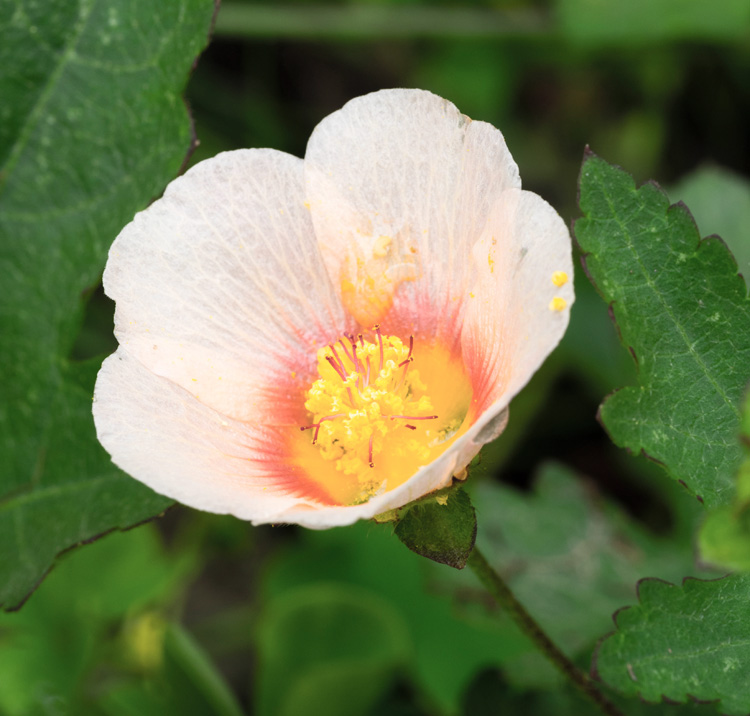
Malvastrum lateritium
TRAILING MALLOW
$5.50 AUD
Availability: In stock
- 1-9 pkts $5.00
- 10 pkts FREE
- Express post $12
Malvastrum lateritium
TRAILING MALLOW
Malvastrum lateritium – the “Trailing Mallow” – is a pretty and downright useful groundcover.
Hardy groundcover with such pretty looks
Trailing Mallow makes a wonderful groundcover.
It is hardy and easy to grow, and will cover the ground; drape down a slope; or spill over an edge very effectively.
Peach blooms like single roses
It bears pretty blooms, like single roses, that sit up and gaze up at you above handsome foliage.
Flowers are a delightful peach colour, each with a central band of deeper salmon and a flutter of golden stamens.
With a beautiful silken texture to the cupped petals.
Over a dense groundcover of downy, fig-like leaves
Handsome deep green foliage also helps make Trailing Mallow such a very desirable groundcover.
Effective weed suppressor
Leaves are downy, shaped like small fig leaves, and densely clothe the trailing stems – so blocking out weeds very effectively.
Scented blossoms
The peachy blooms of have a sweet scent, reminiscent of old fashioned talcum powder and beloved grandmothers.
Long blooming through summer & autumn
And the sweet blooms keep coming all through summer and autumn in a continuous show, giving off that light scent. It is not a bit cloying.
Nectar feast for bees & pollinators
The nectar rich blooms of Malvastrum lateritium provide a feast for useful pollinators, and keep them in your garden with such a long blooming season – continuously right through summer and autumn.
Rabbit & deer resistant
While our foes the rabbits and deer are not attracted to Malvastrum lateritium, instead preferring to pass by on their way to the lettuces. While no plant is completely immune to starving nibblers, Trailing Mallow is not usually bothered.
Care free & low maintenance
Trailing Mallow is blissfully carefree to grow and untroubled by pests and diseases.
As long as it is planted in full sun, or just a little shade (it will become a more sparce groundcover in too much shade).
But in plenty of sun, it forms an evergreen, dense, weed suppressing groundcover that rarely if ever needs trimming. It may root down from the trailing arms, but it is never invasive – making it ideal for helping to bind a steep bank.
Highly tolerant of a wide range of soil pH plus coastal conditions
Good old Trailing Mallow will happily groundcover in just about any soil pH, from acid to alkaline, sandy, gravel or loam; as long as the soil is well drained.
And it is very happy in coastal conditions.
It requires only normal, average garden watering, though it does not enjoy being completely parched.
Tolerates summer heat & humidity
As a native of southern South America – from southern Brazil to northern Argentina – Malvastrum lateritium is perfectly able to tolerate summer heat, and takes summer humidity in its stride.
It also tolerates frost down to approx. -5°C. Though it can take even lower temperatures if it has some overhead shelter. In very cold areas it may be deciduous, but it has to be very cold.
Hardy perennial groundcover
Approx. 30cm. high mounding, dense groundcover, spreading 1 to 1.5 metres wide.
SEED SOWING ADVICE: QUICK & EASY
Suitable for beginners & gardening with kids
Seeds of Malvastrum lateritium can be sown any time indoors when suitable temperatures can be provided (18-22°C).
OR
Plant directly in the garden in autumn, late winter or early spring.
Sow Indoors for optimum germination rate: First soak the seeds overnight in warm water that has previously been boiled. This will help germination to start.
Then sow the seeds in a punnet on the surface of good quality seed raising mix.
And gently pat the seeds to the surface to ensure good contact.
Then barely cover with mix or fine sandy grit – because these seeds need light to germinate.
So not cover deeply.
Now thoroughly moisten the sown punnet by standing it in a shallow water bath.
And allowing the moisture to percolate up to the surface of the mix from below.
Tip for improving germination rates & speed: Seeds of Malvastrum lateritium benefit from a period of warm pre-conditioning, followed by a period of chilling. This will speed up and improve the germination rate, as they think they have had autumn, then winter – but in a compressed period of time.
Seeds like warmth to germinate
Then place punnet in a warm, well-lit position (not in any direct sunlight).
Temperatures of 18-22°C approx. are best for rapid and optimum germination.
You can use a heat mat if you have one, but it is not essential.
This warm pre-conditioning should be for about 2-4 weeks.
Continue to keep consistently moist by misting regularly from a spray water-bottle.
Placing a plastic lid or bag over the sown punnet will help to maintain consistent moisture.
Often this will be enough to break their natural dormancy, and the seeds will begin to sprout without further treatment.
Otherwise – they now need to think it is winter – so wrap the moist, sown punnet in cling-wrap or a plastic bag and place in the fridge (not freezer) for a further 4-6 weeks.
Then remove from fridge, unwrap, moisten again, and place in the warm, well-lit position again.
Continue to keep consistently moist.
Prick out the seedlings as soon as they emerge and grow their first set of true leaves.
Pot on into small pots to grow ready to plant in the garden.
Sow seeds directly in the garden:
Sow in a full sun to partly shaded position in soil that drains well, and rake in gently.|
Continue to keep consistently moist for germination.
Seed Count: 10 seeds per pack approx.
(We always aim to exceed the stated seed count and give a generous serve).
Click here for Nursery Open Days & Open Gardens Information
https://www.gardivalia.com.au/open-gardens
Click here to go back to Seeds Shop
https://www.seedscape.net.au/shop/
Related products
-
 Add to WishlistAlready In WishlistAdd to Wishlist
 -
 Add to WishlistAlready In WishlistAdd to Wishlist
 -
 Add to WishlistAlready In WishlistAdd to Wishlist
 -
 Add to WishlistAlready In WishlistAdd to Wishlist