
Romneya coulteri
CALIFORNIAN TREE POPPY
$5.50 AUD
Availability: In stock
- 1-9 pkts $5.00
- 10 pkts FREE
- Express post $12
Romneya coulteri
CALIFORNIAN TREE POPPY
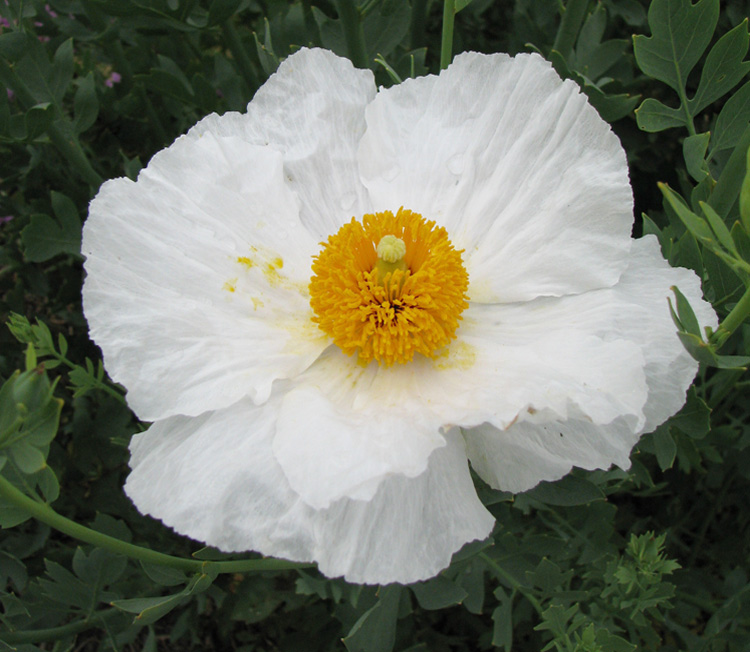
Romneya coulteri bears huge white crinkled blooms with golden centres, looking for all the world like giant poppies. Commonly known as California Tree Poppy.
Huge white crinkled blooms like giant poppies
Flowers also have exceptional texture as well as size (easily make 20cm. across).
As the petals look to have been cut from pleated, tissue thin, silk – Beautiful as well as huge.
With a central boss of egg-yolk yellow stamens.
Scent like ripe summer apricots
And lure you in with a delicious scent like apricots ripening in the summer sun.
Long blooming through spring & summer
Shrubs of Romneya coulteri flaunt their giant, “poached egg” like flowers during spring & summer, with a procession opening over all the hot manths.
So blooms really catch the eye for a long time, especially in difficult positions.
Large blue-grey leaves set off giant “poached egg” blooms
Foliage of Romneya coulteri is especially handsome too.
With large, maple-shaped, velvety leaves of cool blue-grey, borne on strong, tall, upright stems.
So leaves make the perfect foil for snow white and sunshine yellow giant flowers.
A.K.A Californian Tree Poppy
Romneya is commonly known as “Californian Tree Poppy” – which describes it perfectly.
Because it grows tall (1.5m. in tough spots, and even up to 2m. in more generous spots) – has giant poppy like flowers of great beauty – and hails from the deserts of southern California.
Capable in the toughest of spots
So it is happy in even the toughest of positions.
In fact Romneya can become too much of a good thing in better going – so should be planted in tough spots that resemble its native desert habitat.
Drought resistant & water-wise – desert dweller
Californian Tree Poppy thrives in heat, loves dry, and is best in sandy, dry soil that is well drained.
It has an excellent reputation for drought resistance, as befits a natural desert dweller.
Frost hardy too
Plus tolerate frost down to approx. -10°C.
Perfect for binding a bank
Romneya coulteri is a suckering, shrubby perennial, and thrives in poorer conditions – so it is often used for binding a bank where it can have its head to spread.
Sun or Part Shade
Plant in Full Sun where it basks in heat, or Part Shade where it revels in drier conditions and competition.
Treat for bees & pollinators
Who can blame our bees and pollinators when they lose their minds over such huge, pollen laden blooms, with food on offer for such a long time.
Resistant to rabbits and deer
Though rabbits and deer do not find the plants tasty.
Perennial suckering shrub for tough spots
Romneya coulteri is almost indestructible once established, and multiplies by suckers.
But it resents being disturbed or transplanted – so leave it alone to do its own thing where it can have its head.
And it does not mind wandering around in competition with other shrubs.
Upright suckering stems 1.5m. to 2m. High x spreading thickly 1.5m to 2.5m. + Wide.
SEED SOWING ADVICE:
Seeds of Romneya Coulteri are best sown in late autumn and winter.
Sow seeds indoors for optimum germination conditions:
In the wild Romneya coulteri is a pioneer plant after fire – so it responds best to pre-treatment to mimic the effects of a fire passing through.
So purchase some “Smoked Water” liquid or powder form, for seed raising – available online or at your nursery.
Pre-treatment:
First gently rub the seeds between 2 sheets of fine sandpaper to help abrade the hard coating, so moisture can penetrate to the seed kernel.
Then soak the seeds overnight in “Smoked Water” according to the dilution rates on the product.
Now sow the seeds in a punnet on the surface of good quality seed raising mix.
And gently pat to press the seeds to the surface of the mix, but do not cover.
As light is needed for germination.
You can also purchase “Smoked Vermiculite” and a light dusting of this over the seeds will allow the smoke chemical action and also allow light to the seeds.
Now thoroughly moisten the punnet by standing it in a shallow water bath of “Smoked Water”, and allowing the moisture to percolate up to the surface of the mix from below.
Then place in a warm, well-lit position (not in any direct sunlight as this will dry the seeds out).
Continue to keep consistently moist by misting from a spray water bottle regularly.
Temperatures of 16-20°C are preferred for optimum germination.
Some seeds may now pop up without further treatment.
Seedlings usually begin to emerge approx. 21 days after smoking, but will emerge at various times, so do not discard punnet – staggered germination is normal.
But if they are shy to germinate – then they need a pretend winter to break their natural dormancy and stimulate sprouting.
Give a pretend winter
So wrap the punnet in cling-wrap or a plastic bag and place in the fridge for 6-8 weeks.
Then remove from fridge, unwrap, moisten again in “Smoked Water”, and place in the warm, well-lit position at 16-20°C (not in any direct sunlight as this will dry the seeds out).
Seed Count: 30 seeds per pack approx.
(We always aim to exceed the stated seed count and give a generous serve).
Click here for Nursery Open Days & Open Gardens Information
https://www.gardivalia.com.au/open-gardens
Click here to go back to Seeds Shop
https://www.seedscape.net.au/shop/
Related products
-
 Add to WishlistAlready In WishlistAdd to Wishlist
 -
 Add to WishlistAlready In WishlistAdd to Wishlist
 -
 Add to WishlistAlready In WishlistAdd to Wishlist
 -
 Add to WishlistAlready In WishlistAdd to Wishlist