
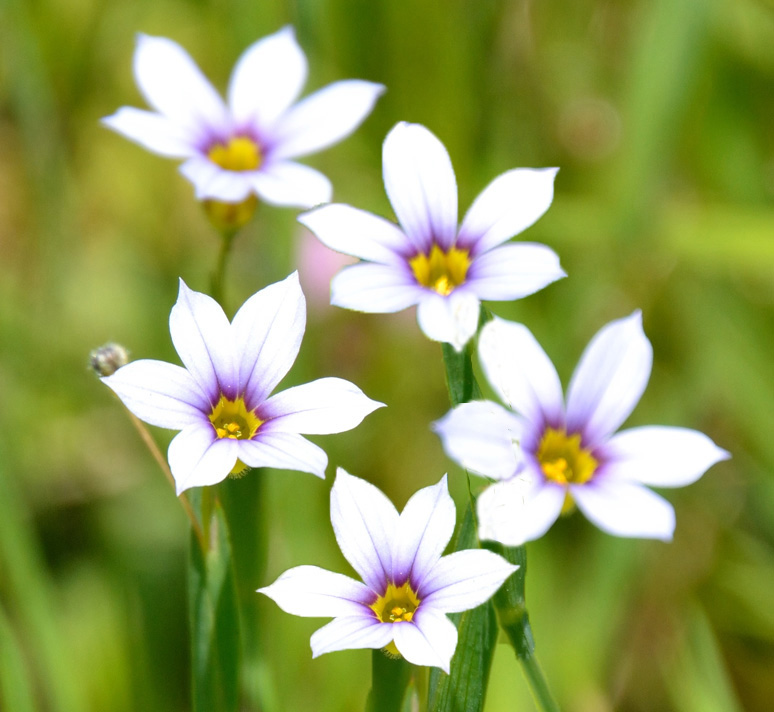
Sisyrinchium angustifolium f. album
WHITE BLUE EYED GRASS
$5.50
Availability: In stock
- 1-9 pkts $5.00
- 10 pkts FREE
- Express post $12
Sisyrinchium angustifolium f. album
WHITE BLUE EYED GRASS
Sisyrinchium angustifolium f. album is the sparkling white form of the thoroughly useful “Blue Eyed Grass”.
Sparkling white stars with blue eyes
Sparkling white star flowers look up at you with their blue eyes.
And twinkle above an elegant tuft of grass-like foliage.
Above a neat tuft of grass-like leaves
But please do not think this is a grass – Sisyrinchiums are just called Blue Eyed Grasses because of the decorative clumps of fine foliage that resemble blades of grass.
They actually belong to the Iris family.
Tight graceful compact foliage
Sisyrinchium angustifolium f. album grows in particularly tight, compact, decorative tuft of foliage 45-60cm. high.
With deep green, fine blade leaves
Flocks of flowers floating above
With the blue eyed, white star flowers sitting on branching stems above.
This is a very graceful plant.
Long blooming over summer & autumn
And the stars just keep coming on a daily basis, all over summer and autumn.
Good cut for small vases
You can cut flower stems right at the base to harvest plenty of star blooms for floral arrangements.
They last well in a vase and have clean stems.
Tough & hardy growth
Plant in Full Sun or up to 1/2 Shade.
Hardy in both frost & heat
Where you will find White Blue Eyed Grass is hardy in both winter frost and summer heat.
Copes well with summer humidity
However it can also cope well with summer humidity, making it a truly useful, adaptable, hardy plant.
Water wise & water saving
As well as being a water-wise, water saving plant – that does not need a great deal of supplementary watering.
It is perfectly happy with average garden watering, hates a bog, though declines in very arid conditions.
Tolerates poorer or sandy soils & seaside
Poorer, less fertile soils, including gravel, sandy and seaside positions are all suitable for Sisyrinchium angustifolium f. album.
It hates poorly drained, heavy soil.
Perfect for edging, groundcover, pots or banks
White Blue Eyed Grass is a perfect plant for making an evergreen perennial edging along a path or in a flower bed; in pots or landscaping a bank.
Perfect because it is brightly flowering, long blooming, neat, compact, and very low care.
Low care
Sisyrinchium angustifolium f. album is a very low care plant.
As it is naturally neat growing; does not need deadheading or pruning; and evergreen.
Though you can shear it back hard at the end of the long flowering seasons, to throw up fresh new growth.
Pest & disease resistant
Virtually nothing eats or pesters it.
Rabbit & deer resistant too
Even rabbits and deer generally find it unpalatable.
Smorgasbord for pollinators
While native bees and honeybees find the star blooms irresistible for gathering both pollen and nectar.
Traditional herbal medicine
Native American First Nation peoples used Sisyrinchium angustifolium to treat stomach upsets and digestive issues. It was particularly favoured for treating diarrhea and to ease fevers.
Long blooming evergreen perennial clump
Graceful, compact evergreen 45-60cm. High x 15-30cm. Wide.
SEED SOWING ADVICE: Needs cold
Sow seed at any time of year in a punnet indoors, whenever suitable temperatures can be provided (20-22°C).
OR
Sow directly in the garden in autumn or winter – to take advantage of the winter cold.
Sow indoors for optimum germination and earlier plants: First sow the seeds in a punnet on the surface of good quality seed raising mix.
Then gently press the seeds onto the mix to ensure good contact.
Now just lightly cover the seeds with sieved mix/ sand /grit / fine vermiculite, but do not bury.
As these seeds need light to germinate.
Thoroughly moisten the sown punnet thoroughly by standing in a shallow water bath so moisture soaks through the mix to the top from below.
Then drain and place in a warm, well lit position (with good indirect light but no direct sun – as this will dry the seeds out too much).
Temperatures of 20-22°C are ideal for optimum and fast germination.
You can also use a heat bed to maintain necessary consistent warmth.
Continue to keep the punnet consistently moist by misting from a spray water-bottle, in the warm position for 4-6 weeks.
Covering the punnet with a clear plastic lid or plastic bag will also help to maintain necessary consistent moisture and prevent drying out.
Then after the 4-6 weeks of warmth – then cling-wrap the moist, sown punnet and place in the fridge for 4-6 weeks (not the freezer).
After the period of chilling (this mimics a winter) remove the punnet, unwrap and moisten the punnet again.
Then place again in the warm, well-lit position at 20-22°C.
Seedlings begin to emerge in approx. 30 days.
But do not discard the punnet as it is natural for these seeds to stagger their germination (this is a natural defence of the plant to ensure some seeds germinate into favourable conditions).
Prick out the seedlings quickly, as soon as they have developed their first set of true leaves.
Pot into small pots / tubes and grow on ready to plant out in the garden.
Seed Count: 50 seeds per pack approx.
(We always aim to exceed the stated seed count, and give a generous serve).
Growing: Sisyrinchium angustifolium f. album WHITE BLUE EYED GRASS
– Height with flowers: 45-60cm. approx.
– Width: 15-30cm. approx.
– Position: Planted in Full Sun to Half Shade.
– Soil: Will tolerate a wide variety of soils as long as they are well drained.
Grows in soils from sandy to clay, gravel to heavy, acid pH to alkaline lime. Permanently waterlogged soils are not suitable, but it cope well with sandy and seaside locations.
– Frost: Reliably frost hardy to -10C and probably below.
– Growth: Evergreen perennial tuft.
Other benefits
– Beneficial for wildlife: Bees and also other pollinators find the flowers very useful. As blooms are rich in both pollen and nectar.
– Care: An easy growing and low maintenance plant. The only work required is an annual trim of the spent flower spires after summer blooming. Additionally a tidy up of old foliage at the same time.
– Deer & Rabbit resistant: Sisyrinchium foliage is not their favourite food because the sword shaped leaves are quite tough and fibrous. However if the munching pests are very hungry, Sisyrinchium may not be completely immune.
– Origin: Native to North America, from cold Canada in the north to hot and humid Texas in the south of North America.
Indicating just how hardy and versatile Sisyrinchium angustifolium f. album is.
Click here for Nursery Open Days & Open Gardens Information
https://www.gardivalia.com.au/open-gardens
Click here to go back to Seeds Shop
https://www.seedscape.net.au/shop/
Related products
-
 Add to WishlistAlready In WishlistAdd to Wishlist
 -
 Add to WishlistAlready In WishlistAdd to Wishlist
 -
 Add to WishlistAlready In WishlistAdd to Wishlist
 -
 Add to WishlistAlready In WishlistAdd to Wishlist