
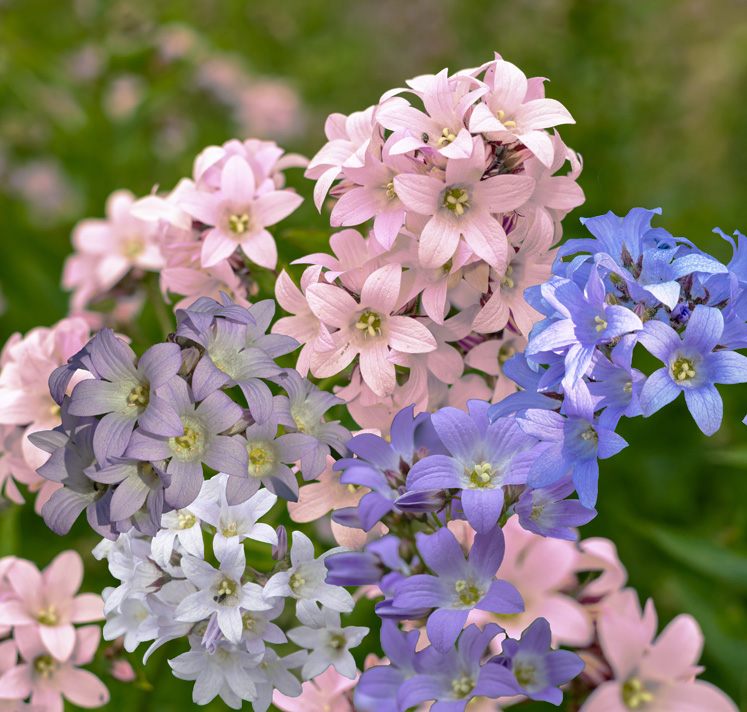
Campanula lactiflora ‘New Hybrids’
NEW MILKY BELLFLOWERS
$5.50 AUD
Availability: In stock
- 1-9 pkts $5.00
- 10 pkts FREE
- Express post $12
Campanula lactiflora ‘New Hybrids’
NEW MILKY BELLFLOWERS
Campanula lactiflora ‘New Hybrids’ is a mix of gorgeous new colours for the spectacular old favourite – the Milky Bellflower.
Glorious mounds of blue, pink, milky-violet, rose & white
This is a mix of seed gathered from all the outstanding new hybrids with the most beautiful colours.
Including a range of blues from soft misty blue to rich deep blue; pink, lilac and lavender; plus white.
Campanula lactiflora is commonly known as the Milky Bellflower, partly because of the lovely creamy texture and colourings of the flowers.
Star flowers in huge billowing heads
The individual flowers are star-like, each with a powdery white centre.
But they come massed by the hundreds on huge billowing flower heads, borne on tall, branching stems.
Majestic specimen – ideal for the centre or back of a bed
Campanula lactiflora is perfect for creating drama and height in the centre or back of a bed, with smaller or less substantial plants in front and around.
Flower mounds soaring from 90cm. to 1.5m. high
The clouds of flower heads can soar up to at least 90cm. during summer, and even on up to 1.5m. on well fed specimens.
These tall branching stems are supported by a rounded mound of foliage stems at the base, which is typically 75cm approx. wide.
This is a large plant, but has no runners and is not invasive.
Summer glory of the garden
And flaunts glorious flower clouds over summer and on into autumn.
Commercial quality cut flower
The tall stems of big waxy bells make superb and long lasting cut flowers.
So they are farmed commercially for the florist trade as well as making tough and rewarding garden flowers.
Not fussy or difficult
Best planted in Part Shade in most gardens, though it will, take full sun in cooler climates.
Campanula lactiflora looks delicate, but is not fussy or difficult.
It is robustly frost hardy, and will make a go of it in a wide range of soils including clay based soils.
Enjoying a soil pH from neutral to alkaline.
So it does like lime in acid soils – lime it when you do the roses.
Low maintenance
Hardy and easy perennial clump, with little work or maintenance involved.
So just shear off the spent flower stems right back to the socks before spring
Otherwise Campanula lactiflora is undemanding and very rewarding.
Long lived perennial
At least 90cm. High in branching heads of flowers x approx. 75cm. Wide mound of foliage.
Once established Campanula lactiflora is a very long lived perennial that pleases every year.
SEED SOWING ADVICE: QUICK & EASY
Scatter directly in the garden in spring or autumn
OR
Sow in a punnet indoors at any time when suitable temperatures can be given (15-20°C).
Sow indoors for optimum germination & quick plants: First scatter the seed on the surface of good quality potting mix.
Then gently pat the seed to the surface of the mix to ensure good contact, but do not cover with mix.
Because these seeds need light for germination.
Tip for sowing fine seed: Campanula seed is very fine – so it can be difficult to get out of the bag and sow thinly and evenly.
The best trick is to finely sieve some of the seed raising mix. Put a few pinches in the bag with the seed. Then shake like mad to pick up the seed.
Now add this to an even greater quantity of sieved seed raising mix and finally sow the lot.
You will now be able to spread it further and more evenly.
Now thoroughly moisten the sown punnet by standing it in a shallow water bath.
And allow the moisture to percolate up to the surface of the mix from below.
Then place the moist, sown punnet in a warm, well-lit position.
You can use a heat mat if you have one.
But it is not essential as a warm window sill is also suitable.
Because these seeds are willing germinators.
Temperatures of 15-20°C are best for rapid and optimum germination.
Continue to keep consistently moist by regularly misting from a spray water bottle.
Covering the punnet with a clear plastic lid or bag will also help to maintain necessary consistent moisture.
Seedlings emerge in approx. 14-28 days.
Prick out the seedlings as soon as they develop their first set of true leaves, and pot up to grow on to garden size.
Seed Count: 150 seeds per pack approx.
(We always aim to exceed the stated seed count and give a generous serve).
Click here for Open Gardens Information
https://www.gardivalia.com.au/open-gardens
Click here to go back to Seeds Shop
https://www.seedscape.net.au/shop/
Related products
-
 Add to WishlistAlready In WishlistAdd to Wishlist
 -
 Add to WishlistAlready In WishlistAdd to Wishlist
 -
 Add to WishlistAlready In WishlistAdd to Wishlist
 -
 Add to WishlistAlready In WishlistAdd to Wishlist